
Three years ago, the Metinvest group of companies developed its own concept of housing construction project for internally displaced persons from the territories, occupied by the Russians. Now, this technology has become an obligatory requirement of the tender for designing a quarter for refugees from Bakhmut in the Rivne region, and other requirements actually narrowed the group of bidders down to companies with the experience of designing in Metinvest objects.
But the main interest of Metinvest lies in supplying steel constructions worth hundreds of millions of hryvnia. And all this is merely for one project, while Metinvest plans to launch a total of over 30 such projects in Ukraine.
NGL.media sought to know how the company of the richest businessman of the country, Rinat Akhmetov, is trying to create the “gold standard” for the post-war reconstruction of Ukraine.
Quality investigations require much time, efforts, and money. Join hundreds of participants of NGL.media community, who support this complicated work.
A free gift
The concept of the “Steel dream”, envisaging fast construction of buildings with steel structures, was first presented by the Metinvest group of companies back in May 2023. Yurii Ryzhenkov, the director general, didn’t hide the fact that it was Metinvest that intended to supply steel for this project.
“The company will not only supply steel for construction, but also use its own experience and expertise to make the reconstruction process more efficient, faster and simpler. Being a large business, we shouldered the responsibility of elaborating the general concept of reconstructing the country. I hope it will become an impetus to implement dreams into actions,” Ryzhenkov claimed then at a business forum in Kyiv.
Fortune is known to favour the bold. During the two following years, Metinvest persistently promoted its idea which lay in a set of solutions for housing construction and social infrastructure, which can be adapted to the needs of specific communities.
The concept of “Steel dream” is based on the house, which is a construction set – a steel structure with precast panels for walls and floor structures. The company developed about 200 ready house projects based on three preliminarily fabricated steel elements: a frame, a module, and a platform. Each project contains the full set of documents – the estimate, construction schedules, planning, and technical solutions.
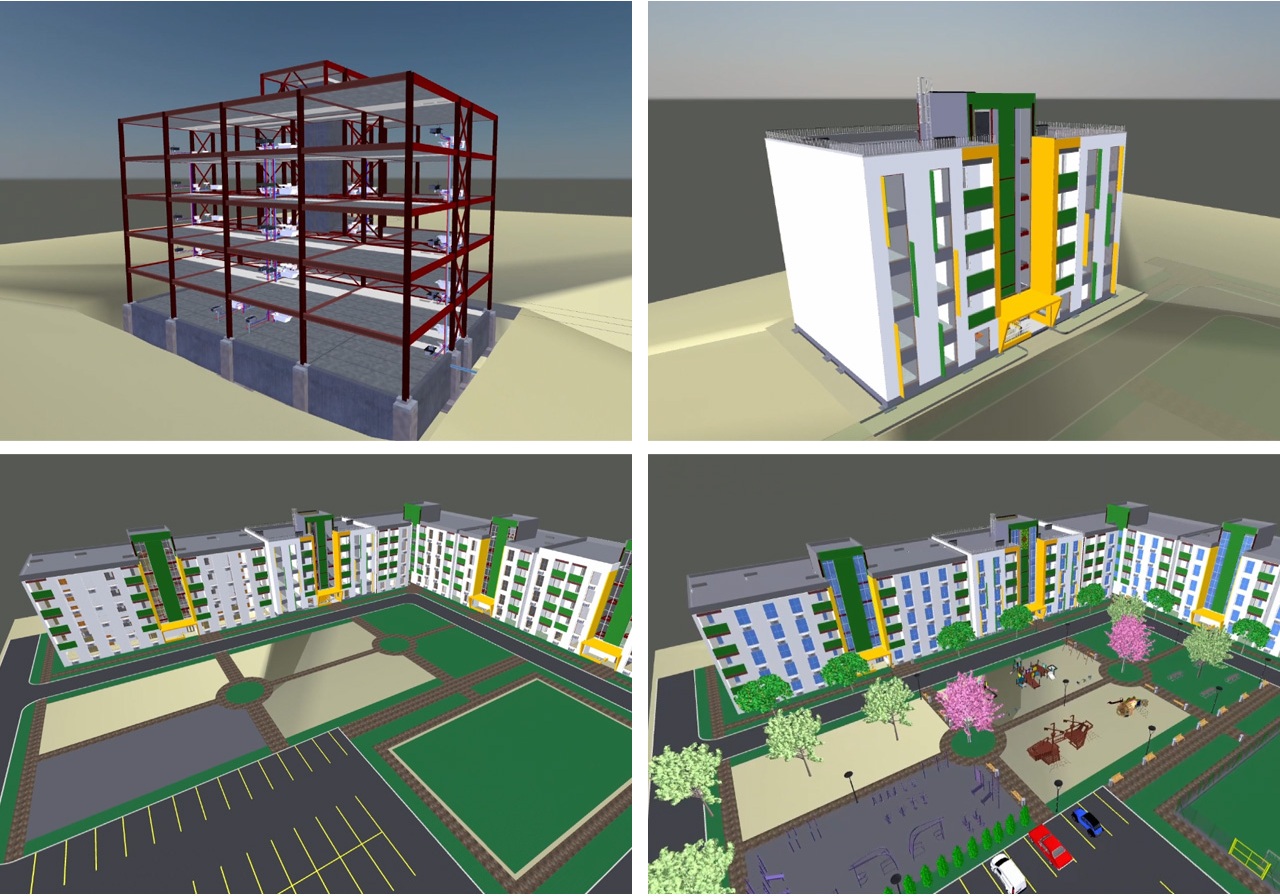
The concept of housing construction using a steel frame, suggested by Metinvest (visualization by Metinvest)
In 2024, the “Steel dream” was in the short list of the competition “Partnership for Sustainable Development” which runs under the auspices of the UNO. The website of the competition states that the concept was adapted free of charge to construct housing for 18 thousand former residents of Bakhmut and 10 thousand residents of Mariupol. About 30 more communities around the country expressed their interest in the “Steel dream” concept.
A miniature copy of Bakhmut
Russians occupied Bakhmut in December 2023 having practically destroyed it completely during their attacks. More than 80 thousand people used to live there prior to the war, and all of them were left homeless.
There was a decision to build new housing for some refugees in the Rivne region – in the town of Hoshcha of about five thousand people. Last May, a memorandum was signed, pursuant to which the town council would allocate up to 10 ha of land, and the Bakhmut city military administration (CMA) is to build a residential quarter for refugees and transfer it to the municipal ownership of the community.
The construction project in Hoshcha envisages creating something like a miniature copy of Bakhmut with the conditional division into districts and restoration of iconic locations: the embankment, the alley of roses, etc. The first stage envisages constructing houses of steel structures for 570 apartments, a shelter, a school, and utility systems. The housing in the first stage is envisaged to accommodate a total of 1,200 people.
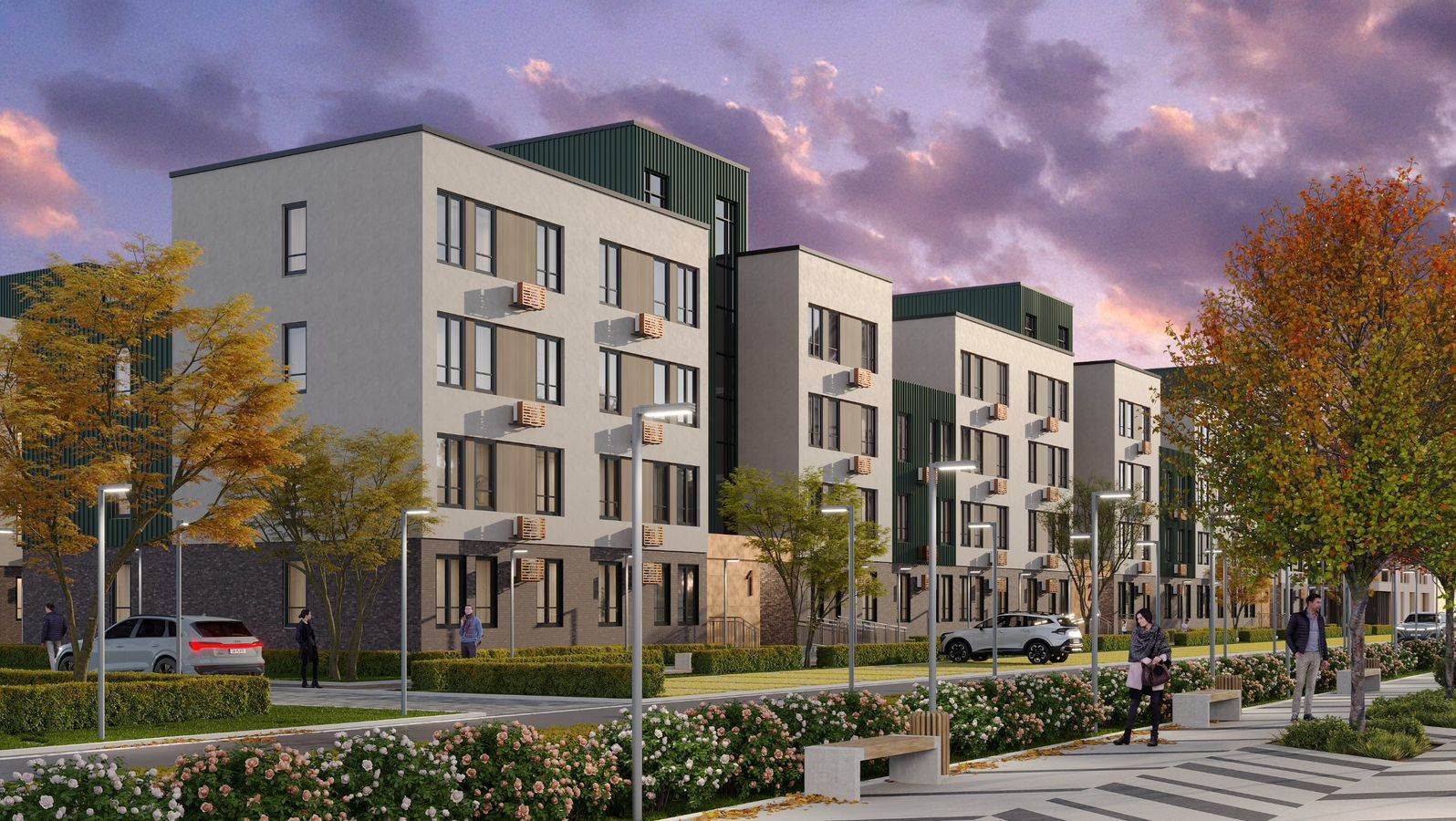
Typical houses, the construction of which is planned for former Bakhmut residents in the town of Hoshcha in the Rivne region (visualization by Metinvest)
The cost of the first construction stage is evaluated at UAH 919 mln. They plan to get finances from the state budget as well as international donors and investors. In November 2025, at the international conference in Warsaw, Natalia Kozlovska, the deputy Minister of community development, presented this project to the representatives of the European Commission, the World Bank, the EBRD, the EIB, and other international donors. At the same conference, Kozlovska told about a similar project of housing construction for Mariupol residents in Bila Tserkva.
In both projects, the technology is the same, the one suggested by Metinvest to communities two years before.
Why steel, exactly?
In the Rivne region, they decided to implement the project starting with the elaboration of project documentation. The tender for its elaboration, worth almost UAH 62 mln, was announced in February 2026. It was at this stage that a key solution was laid out – these would be houses with a steel frame.
At the stage of proposal consideration, the potential tender bidders complained of discriminatory conditions, set from the very beginning. NGL.media talked to several complainants. They claim that the procurement requirements were written specifically for the steel frame, although this technology is practically not used in residential buildings.
Realizing that these complainants may be biased, NGL.media asked independent designers. Opinions were different. Some say that residential buildings aren’t built like that in Ukraine, the steel frame is used for industrial objects, offices, and trade centres. Others say that this construction is possible but not common.
However, all the experts come to the same point: there has to be a substantial technical reason for this solution. Why? Because it is more expensive, since a steel frame requires special fire barriers, whereas a concrete frame or brick walls don’t.
Oleh Hrechukh, an architect from Kyiv, says that the only residential building with a steel frame in Kyiv, known to him, was built in 2004-2005, and that was done due to unique conditions of the land plot next to old buildings with small basements. “It is generally hard to explain why this technology is required in empty land plots in Hoshcha,” he believes.
Steel or concrete and brick?
To make an atypical solution look substantiated, the Bakhmut authorities ordered a technical and economic estimate (TEE). This is a document which compares several construction variants and explains the selection of the one, most reasonable from the economic standpoint. It would be more complicated to announce the tender with a specific technological requirement without the TEE.
The Bakhmut city council confirmed for NGL.media that it hadn’t conducted a competitive selection of the developer of the TEE, taking advantage of procurement simplifications during the martial law. The document was prepared by the Architectural and Planning Bureau LLC. No other designers were involved.
The technical and economic estimate was transferred to the municipal entity, the Bakhmut residential management company, which was made responsible for construction in Hoshcha. This enterprise announced a tender for the elaboration of project documentation for a quarter construction for Bakhmut residents.
The technical and economic estimate compared two variants. The construction using a steel frame was estimated at UAH 919 mln, and the more traditional one of concrete and brick – at UAH 934 mln. The price difference was under 2%, and on this basis the TEE developer recommended a steel frame as “more economically reasonable”.
However, independent experts explain that the TEE compares only estimates, not technologies. There should have been separate technical substantiation for the atypical construction solution, like a steel frame for a residential building: laboratory testing, checking for deviations from standard norms. Nothing of the kind was conducted.
“I don’t think there were two complete projects with estimates for two different technologies. They calculated using preliminary conditional abstract estimates and conditional prices. They put some coefficients on paper. It is not a conversation about actual projects with their advantages or drawbacks, but mere work with figures,” architect Oleh Hrechukh says.
In December 2025, the technical and economic estimate received a positive expert report, but the conclusion contains a direct warning, “During the examination, the technical and technological parts of the design documentation for construction weren’t considered.” So, nobody checked independently whether the metal frame is the best solution for a residential house, and the examination just confirmed that the figures were calculated accurately.
A tender for one
Tender documentation for the elaboration of project documentation for the construction in Hoshcha contained a specific qualification requirement: a participant was to submit a certificate confirming the completion of similar contracts for residential projects with a steel frame in liability classes SS2/SS3 The class of consequences (liability) defines how serious the consequences may be in case of an accident or ruination of a building. SS2 and SS3 are given to buildings, the ruination of which may result in considerable material losses or be a threat for a large number of people with the confirmation by a positive expert report. So, the experience in designing residential buildings isn’t enough, there is a requirement for experience in designing residential buildings only with a steel frame and with the corresponding class of liability.
No formal violations of the law on public procurement were present in the tender: the tender documentation didn’t contain direct references to the producer. However, the experts of the construction market, surveyed by NGL.media, believe that the combination of requirements “residential building + a steel frame + class of liability SS2/SS3 + a positive expert report” narrowed a circle of potential bidders to practically one in Ukraine. The one that built the university complex of Metinvest Politechnika in Mariupol.
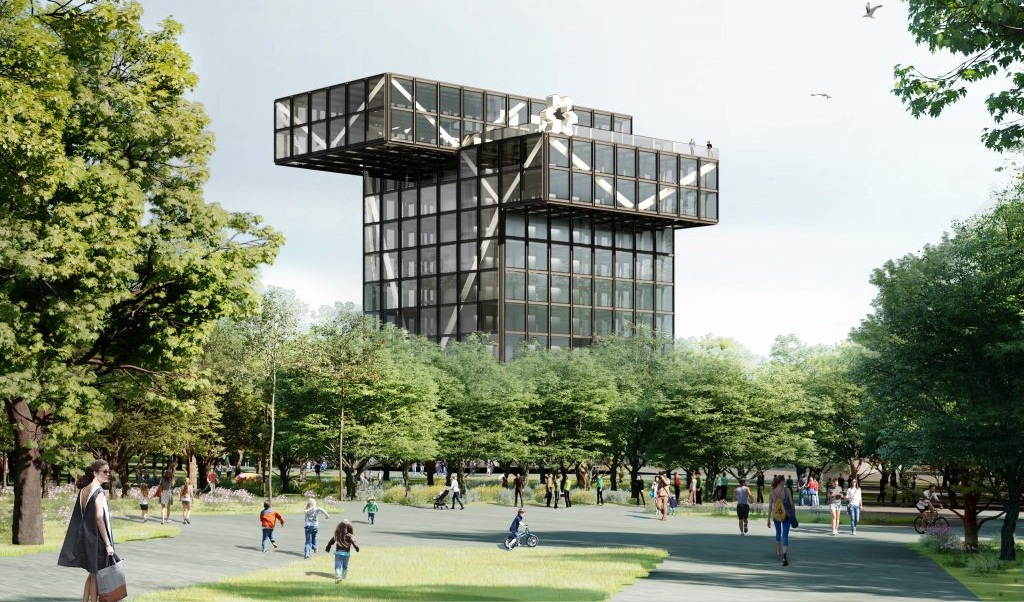
The visualization of Metinvest Politechnika in Mariupol. The project wasn’t completed due to the Russian invasion
The bidders understood it too. One of them asked directly in the Prozorro system whether the client understood that there were practically no companies with such experience in Ukraine, and that no company, but Metinvest, could win this tender. The client didn’t deny it, just indicated the possibility for the participation of foreign companies.
Two companies took part in the tender. SE Scientific research and design institute of bridge building offered UAH 44.9 mln, but this offer was declined exactly due to the absence of experience in designing buildings with a steel frame. The winner was Ukrainian Architectural Technologies LLC with the offer of UAH 61.8 mln which confirmed its experience by the project of Metinvest Politechnika complex.
The submitted documents don’t state Metinvest Politechnika as the direct client of a similar object, instead, it states Dragon Evolution LLC, a company which was a developer, acting in the interests of Metinvest Politechnika. So, the association with Metinvest in the documents is indirect, it is hidden via an intermediate structure.
During the monitoring, the State Audit Service (SASU) found a violation: the Ukrainian Architectural Technologies hid the amounts and agreement prices in similar agreements, having specified them as confidential information. Pursuant to the law, the documents confirming the correspondence to qualification criteria cannot be confidential. The SASU demanded that the client should break the agreement.
The Bakhmut residential management company didn’t agree to this conclusion, because, in their opinion, the violation neither impacted the process of determining the winner nor resulted in illegal use of budget finances. As of the moment of appealing, 20% of work had already been completed and the first amount, UAH 3.28 mln, had already been paid. At present, the client appeals the SASU resolution in court, and the agreement with the Ukrainian Architectural Technologies remains valid.
A monopoly for standard
Despite a dispute over the tender for project design, the main issue remains – who will supply steel? “There is a question about the producer of these steel constructions – who exactly can produce them for atypical residential construction? Project elaboration is mere pennies as compared against the producer’s income,” Heorhii Mohylnyi, an independent expert in city building issues, explains.
It should be repeated that the “Steel dream” concept has been developed and is being promoted by Metinvest, Ukraine’s largest steel producer, which defines the construction standard. And it is Metinvest that has ready solutions for required steel constructions.
Figures give an idea about the scale. Metinvest even published a separate book, “Steel Dream”, which says that one residential house of four floors and two sections requires 208 tonnes of metal. The first stage of construction in Hoshcha envisages 20 such houses. So, only the first stage of construction will need about 4,160 tonnes of steel constructions. As of June 2026, Metinvest sells such IPE profiles steel H-beams with the “H”-shaped cross-section at a price of UAH 42-46.5 thousand per tonne. Thus, the mere cost of metal for the first stage of construction in Hoshcha will amount to approximately UAH 180-190 mln. The total cost of steel construction for the implementation of the entire project in the Rivne region will exceed two billion hryvnias.
At the same time, Metinvest promotes similar projects in Bila Tserkva in the Kyiv region, in Trostianets and Hlukhiv in the Sumy region. According to the data by Metinvest, there are about 30 more applications from communities around Ukraine.
NGL.media asked Metinvest to comment on the abovedescribed circumstances. The company confirmed that they elaborated the construction concept in Hoshcha in collaboration with the Bakhmut CMA but denied any involvement in preparing the tender for project design and interacting with its winner, Ukrainian Architectural Technologies LLC. Metinvest insists that the concept is given to communities free of charge and without any obligations to procure the products of the group, and the commercial gain may be considered “only within official tender procedures with the participation of Metinvest on general conditions”. Above, NGL.media’s material describes exactly what these tender conditions look like.
To find out, whether the “Steel dream” concept has any official status for application in housing construction, NGL.media made inquiries to state bodies. The State Research Institute of Building Constructions (SRIBC) forwarded the question to the Ministry of Development, so did the State inspection of architecture and city building of Ukraine (SIAC).
As for the Ministry, they say that “the ‘Steel dream’ concept wasn’t submitted to the Ministry, and no solutions regarding its approval or confirmation were taken”. The Ministry specified that the application of steel frames in housing construction isn’t prohibited by the current norms, but the structure is to meet the requirements to fire safety, sound isolation, and energy efficiency.
Yet, no authority took the responsibility to either confirm or deny the applicability of the concept for housing construction.
Author Aliona Malichenko, editor Oleh Onysko, translation Nelya Plakhota, cover Viktoria Demchuk
