
Objective figures prove that Ukraine has no problem with foreign migrants. Yet virtual reality replaces actual reality ever more often. That’s why several imprudent phrases, stirred up by the Russian propaganda using ever more refined technologies of artificial intelligence, create an illusion of the prevalence of migrants.
A wave of street protests against occupational migration has already swept across Ukraine. These small-scale protests are currently organized by some representatives of the far-right movement and, surprisingly, by some immigrants. However, anti-migrant rhetoric is now coming even from some quite respectable politicians.
NGL.media decided to investigate why a rather typical Russian informational and psychological operation turned out to be an unexpected success and which Ukrainians played a remarkable role in it.
Migrants against migrants
May 25, a hot afternoon. There are usual crowds near the monument to Taras Shevchenko in the centre of Lviv. Amid random passers-by and groups of teenagers, there is a distinct small group of people, holding signs – these are the participants of the meeting against massive occupational migration. Nicolas Imbert, a 30-year-old immigrant from France and a leader of the protest, is seen from a distance – he is making comments to several journalists who came to cover this event.
“I don’t have any other intentions, I just want to help Ukraine. Please don’t make the mistake we made in France, in Europe. I am not saying that there is a massive influx of occupational migrants right now. I say: Let’s stop this process until it is too late”, Nicolas Imbert explains in fluent Ukrainian with a distinct French accent.
At first, about ten people gathered around him, holding self-made signs like “Ukrainians should have the priority”, “This is not the country our beloved ones are fighting for”, later they unwound a professionally made black-and-red banner “To rule not over others, but over one’s own land”. In the course of another hour, about 30 passers-by came to listen to the Frenchman, his Ukrainian wife, and another protester from the Netherlands, who also spoke Ukrainian. Several representatives of Ukrainian special forces pay close attention to the proceeding of the meeting.
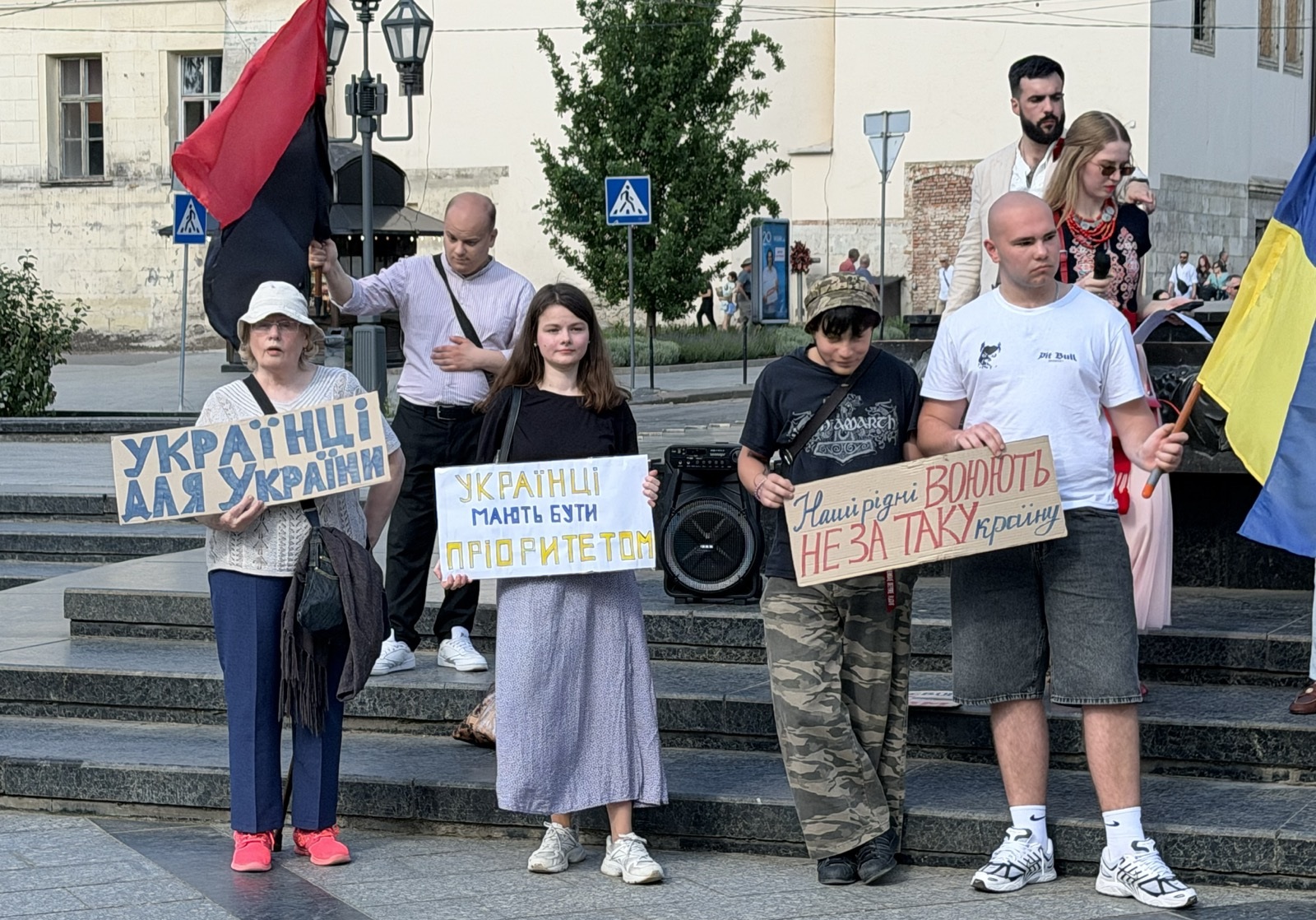
The protest against occupational migration in Lviv, May 24, 2026 (a photo by NGL.media)
The rhetoric of the protesters is rather controversial. They call on Ukrainians, who often are occupational migrants themselves, to come back to Ukraine and at the same time emphasize the danger of bringing occupational migrants into the country. At the same time, they admit that there is no flow of migrants to Ukraine at the moment.
At the end, Nicolas Imbert announces the registration of the NGO to fight immigration and calls on the present audience to come up with their ideas to solve the personnel deficiency without the use of foreigners.
Occupational migrants are involved in work in Ukraine. But this is absolutely not a mass phenomenon.
The issue of occupational migration periodically appeared in the public media for at least the last two years. However, it is in May 2026 that the discussion of this issue has evolved into massive hysteria on social media, which is nurtured by the Russians, producing numerous fakes and manipulations.
“Migrants are a part of an anti-drafting campaign held by them [Russians], and its main message is that Ukraine allegedly kills its own citizens to bring free or cheaper labour force into the country. And this vector has been present here for at least the second year in a row,” Oksana Moroz, an expert in communications and combating disinformation, claims.
The May wave was preceded by a few events that could have evolved into a public discussion about occupational migration, but caused turmoil instead.
In early April, during a meeting with business representatives, Kyrylo Budanov, the head of the President’s Office, made a remark about the possibility of simplifying the procedure of attracting occupational migrants. A few weeks later, there appeared a blog post of Dmytro Karpenko, the director of the outsourcing company Fillin, about a draft law No. 14211, elaborated by the government which, if adopted, could have really simplified this procedure. That’s when Olena Shuliak, a people’s deputy, said on TV about the need to attract foreigners, including the building sector which suffers from the shortage of labour force.
On May 1, social media started sharing the screenshot of the announcement in the house chat, in which the Blago company from Ivano-Frankivsk warned about hiring cleaners from India. Then, the company manager clarified that migrants would work on the construction.
At the same time, Blago attracts occupational migrants for their construction projects since 2024. These are not millions or hundreds of thousands, but only a few dozen workers every year. Other companies follow the same route. Oleksii Koval, the head of the building company, claims that the crisis in the building sector cannot be solved using only the internal resources of Ukraine.
“There are 5-6 mln Ukrainians abroad according to the recent data, 5.6 mln Ukrainians left Ukraine, including 1.3 mln who went to the RF or Belarus. Even in the most optimistic scenario, a considerable number of them will not come back in the near future or at all. As a result, the building sector faces a shortage of 150-200 thousand workers. In case of active reconstruction, this figure may reach up to 500-800 thousand even in case of satisfying the need in part and having reconstruction periods of over ten years. This is not a temporary imbalance but a new market reality,” the builder claims.
The building sector is one of the most migration-dependent sectors of the economy in the world. In the neighbouring Poland, about a quarter of all workers in the building sphere are occupational migrants, many of them are from Ukraine but there is also an increasing number of occupational migrants from Asia and South America. As for the Poles, they go to work in western European countries – Germany, Norway, and Great Britain. So the workers from the countries with smaller salaries go to the places, where they can earn more for the same job. This is the very point of occupational migration.
Actually, builders can earn nicely in Ukraine, where the average salary in this sector reached almost USD 1,000. For comparison, in Kyrgyzstan, the salary is USD 470, and in Bangladesh, builders earn less than USD 100 a month. So, it is not surprising that the citizens of poorer countries may consider Ukraine as a place to earn money. However, one cannot call it a mass phenomenon. This is proven by official figures.
According to the data of the State Employment Service, obtained by NGL.media, before the war, foreigners received over 16 thousand work permits every year. After the Russian invasion, this index dropped to 3-4 thousand – it started rising gradually only since 2024, but it is way below the pre-war level. Last year, fewer than 7.5 thousand work permits were issued to citizens of over 80 countries.
The geography of the occupational migration changed, too. Before the war, the main donor countries were India, Turkey, Belarus, Uzbekistan, and Russia. Now, Belarusians and Russians are replaced by citizens of Bangladesh and Azerbaijan. The Chinese have almost come back to the pre-war level – they are usually brought by Chinese investors to work at their own enterprises.
It should be noted that, contrary to a gradual increase in the number of issued work permits, the number of permits for immigration decreases. It seems like most foreigners are not in any haste to settle in Ukraine. Last year, the State Migration Service issued only 2,851 immigration permits, which is the lowest index in the last 10 years.
Two groups organized protests against occupational migrants in Ukraine at the same time. One group consists of avowed racists and the other is headed by the immigrant.
Anonymous channels in social media became an ideal platform to share the ideas about occupational migration. According to the data of the Centre for Strategic Communications, only in the first decade of May, there appeared 6 thousand posts on this topic in Telegram, and 8 thousand more – in Facebook.
Open AI-generated fakes are actively spread by anonymous sites as well. For instance, little-known news resource “Tvoi novyny” spreads them in dozens of its regional pages on all social media. They can be recognized by simple logos. Although this resource doesn’t have as large an audience as, let’s say, Truha network, still the content about migrants, who had a fight with Gypsies or did their laundry in the river, is wide-spread.
And even the media with well-known owners and not bad reputation couldn’t restrain themselves from spreading the fakes and manipulative narratives.
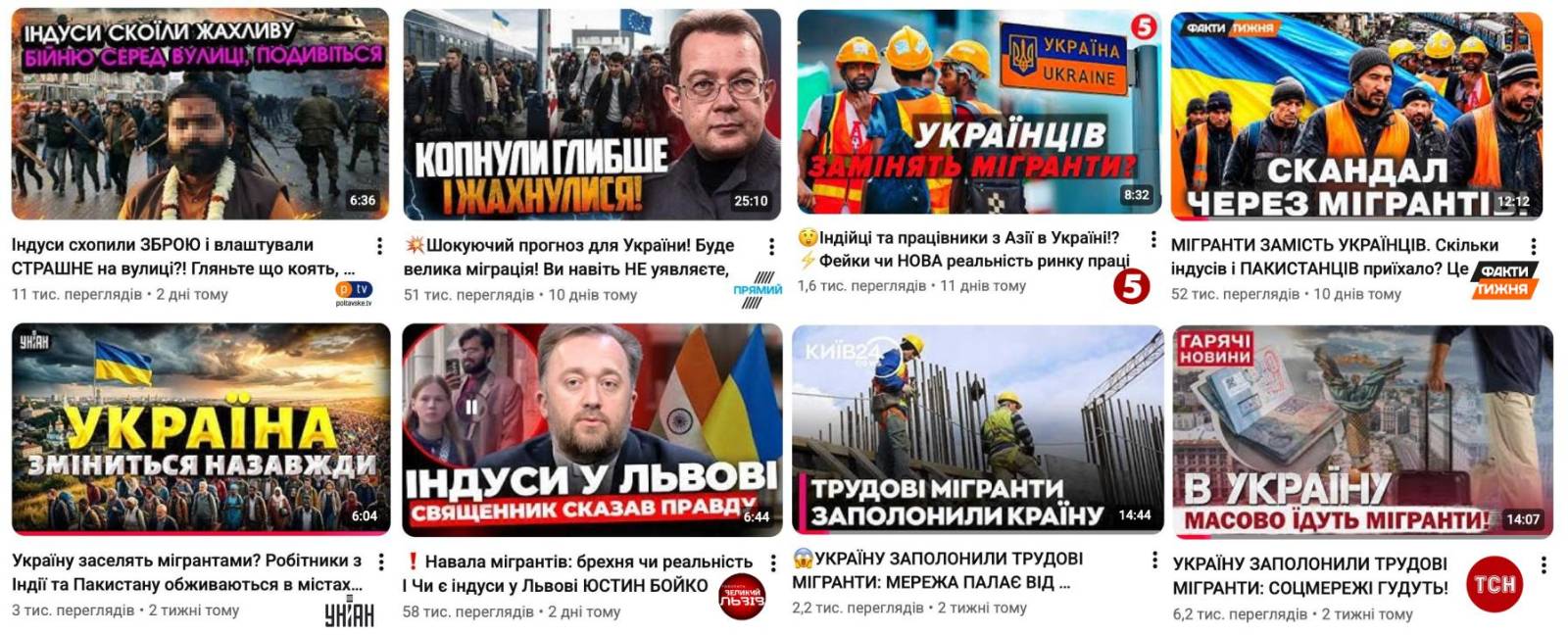
These are just a few examples of video titles from a Ukrainian TV channel on YouTube (a collage by NGL.media)
At some point, the information space has become so overwhelmed with the issue of occupational migrants just enter “occupational migrants” in YouTube search: the number of provocative titles will surprise you that it became clear – something has to be done. While the respected media tried to show the groundlessness of mass hysteria on social media, the opposite party started shouting slogans for action.
On May 11, Yulia Chubarieva, a 27-year-old Ukrainian, registered a petition on the government’s website with the requirement to have Ukrainians be exempted from drafting instead of bringing in occupational migrants. This is not the only petition with such content but this one collected 25,000 signatures, required for the petition to be considered, in mere 10 days. The author succeeded due to public disclosure: she and her husband have blogs on Instagram and Tik-Tok.
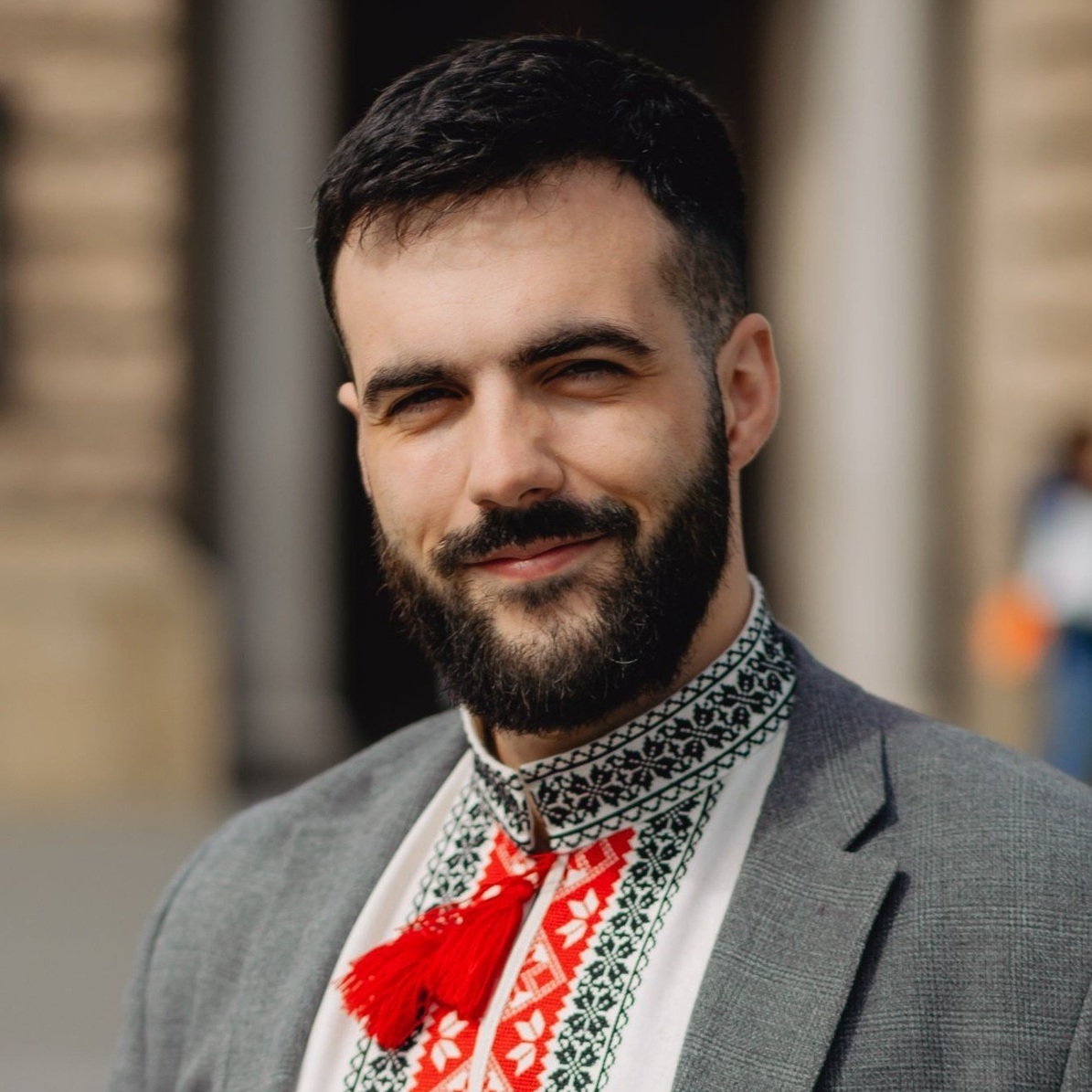
Nicolas Imbert (a photo from Facebook)
Chubareva’s husband is an immigrant from France, 30-year-old Nicolas Imbert. He calls himself a religion expert, political scientist, and public figure. Last year, the state TV channel “Dim” featured him as an example of a foreigner who loved Ukraine so much that he learned the language on his own and chose to live here permanently.
Previously, Chubarieva and Imbert shot educational videos about the French and Ukrainian languages and showed their life. Nicolas Imbert has his own online school of French, so this topic was a logical choice. However, in May, the couple focused on the topic of migration, and the tone of their calls immediately became harsh.
On May 5, Nicolas Imbert recorded a video with a clearly provocative message: “While Ukrainian men die in the war, here we are, attracting migrants with absolutely different culture, absolutely different religion, and absolutely different attitude to women.” Then, to the disturbing music, he reminded of a well-known story about gangs of immigrants, raping girls from orphanages in England, projecting it on Ukraine’s future. Now this video has almost 50 thousand reactions and 30 thousand shares.
Then, the couple started calling Ukrainians to come to the protests against occupational migration. For this reason, Nicolas Imbert and several more like-minded people created a movement in social media, which they called “Maibutnie ukrainskoho narodu” [The Future of Ukrainian People] (MUN). Among its members are activists from a little-known organization “Pidpillya”, which positions itself as an educational platform. The founder of the movement is Kateryna Taran, a singer from Ivano-Frankivsk.
In addition to the abovementioned people, an active organizer of protests against occupational migration is a Kyivite director and blogger, Mykhailo Manastyrskyi. Before May 2026, he used to record short videos about church, the construction of an orphanage that he works with, and against abortions. Now he has focused on criticising migration actively and spreading rumours.
Recently, the MUN posts also featured Yurii Kamelchuk, a people’s deputy from the Lviv region, a well-known supporter of conspiracy theories and disseminator of disinformation.
In May, Manastyrskyi and Imbert announced protests against “mass occupational migration” in large cities of Ukraine. These were to take place on May 23. However, the date was transferred to May 24 due to possible provocative actions, in the words of Mykhailo Manastyrskyi. He obviously meant the activation of the far-right forces who also put the topic of occupational migration on their banner and announced their own protests.
On May 16, the members of the right-wing organization “Bratstvo” of Dmytro Korchynskyi held a protest in Kyiv which collected about 30 people. Several more dozens of the members of such movements as “Bilyi sektor”, “Prava molod” and others came to protest in Kyiv on Saturday, May 23, with clearly racist slogans “For white Ukraine”, “Nation, race, family”, “Go away from Ukraine, an ugly migrant!”, etc. Some members of these protests covered their faces with balaklavas. Similar, not large-scale, protests took place in several more cities in Ukraine.
Ukrainian politicians also carried manipulative narratives about occupational migration to the people. This is populism, exploiting the fears of Ukrainians.
“Today, they are trying to quietly impose a dangerous idea on us: allegedly, the outflow of people is not a problem. Allegedly, it is enough to “attract” hundreds of thousands of migrants more every year – and everything will work,” said Ihor Terekhov, the mayor of Kharkiv, on April 15. Basically, the mayor repeated the manipulative narrative of the Russian informational and psychological operation: it seems like Ukraine has forgotten about its citizens and replaces them with foreigners.
And a month later, the Association of Frontline Cities and Communities, headed by Terekhov, addressed the government with a direct request not to “allow mass involvement of occupational migrants”.
The mayors of other cities spoke against the involvement of occupational migrants too, for instance, Ruslan Martsinkiv, the mayor of Ivano-Frankivsk, and Andrii Sadovyi, the mayor of Lviv. The arguments were roughly the same as those from Terekhov: we are bringing our people back, not bringing foreigners in.
“I am not in favour of bringing dozens, hundreds of people. What if they don’t leave.” And these are different religious and mental views […] One just has to pay people an adequate salary. And I am sure that some people will come from abroad […] And they should be brought back first of all, this is what I would emphasize,” Andrii Sadovyi believes, for example.
The opponents of occupational migration also entertain a popular thought about the need to involve foreigners in the army service if they want to work in Ukraine. For instance, this idea was expressed by Maksym Zhorin, the deputy head of the Third Army Corps.
“Do you want them to be able to work here? Then let’s make a decision that they can get here only via the army. Otherwise – what are we fighting for? For grinding down our ethnic cultural group as Ukrainians? That’s what we really wouldn’t like,” Zhorin said in his interview for the History without Myths channel.
By the way, the Third Army Corps actively attracts foreigners to serve in it. The total number of foreigners in the Ukrainian army is not disclosed, but, for instance, about 7,000 recruits came from Colombia, as per approximate estimates.
The fakes about occupational migrants were spread by other politicians as well. For instance, Artem Dmytruk, a sanctioned people’s deputy who fled the country, shared the AI-generated video about a migrant as a member of the notification group of the TCC in Cherkasy. And the people’s deputy, the member of the European Solidarity party, and the member of the PACE migration committee, Oleksii Honcharenko, spoke in the Verkhovna Rada with an emotional call not to allow the inflow of occupational migrants to Ukraine. He used the same argument as Trukhanov and Sadovyi did – bring Ukrainians back from abroad, don’t bring foreigners in. The video was shared in the regional groups of European Solidarity on social media which is evident proof of the coordinated party position.
Actually, when one listens to Honcharenko, Terekhov and other opponents of occupational migration, one might ask a logical question – in what way are they wrong, after all? Should Ukrainians be brought back from abroad? They should. Should salaries for servicemen be increased? No doubt. Should Ukrainians be paid decent salaries? 100%. Should vacancies be created for Ukrainians? It goes without saying. However, binding these issues, relevant for Ukrainians, to the topic of occupational migration creates manipulative dilemmas like “either occupational migrants, or Ukrainiansmigrants”, though one doesn’t rule out the other.
Author Kateryna Rodak, editor Oleh Onysko, infographics Maksym Piho, translation Nelya Plakhota, cover Viktoria Demchuk
