
Last year, in Ukraine, there was a wave of inspections of the employees of law enforcement and other state bodies who receive their disability pensions. It turned out that almost half of the resolutions on determining the disability had been unfounded. Massive inspections are still ongoing, they started when a large percentage of prosecutors with disabilities was found in the Khmelnytskyi region. After the inspection, most prosecutors had their disability status revoked.
NGL.media found out that prosecutors from Khmelnytskyi have been successfully banning the inspection results in the local court. Over 30 local prosecutors went to the court and more than half of them already received positive resolutions and got their disability status back.
Quality investigations require much time, efforts, and money. Join hundreds of participants of NGL.media community, who support this complicated work
What happened and what did we find out?
In October 2024, when the head of the Khmelnytskyi Regional MSEC Municipal health care institution of the Khmelnytskyi regional council “Khmelnytskyi Regional Medical and Social Examination Commission” Tetiana Krupa, was detained, it triggered a scandal which went far beyond the borders of the Khmelnytskyi region. She was found to be fabulously rich – only during the search, the ESB specialists found almost USD 6 mln in cash in her office and apartment, then they found dozens of real estate objects in Kyiv and Lviv, in Spain, Austria, and Turkey in her family’s ownership, millions of dollars on foreign accounts, elite cars, etc.
These findings gave rise to the obvious assumption that the main source of such Tetiana Krupa’s income was her activity as the head of the regional MSEC. The most evident article of “income” in this position is bribery for the determination of the disability group, which envisages significant social payments.
Not long after that, Yurii Butusov, a journalist, posted a list of names of 50 local prosecutors Butusov’s list stated 51 surnames but it was a mistake because prosecutor Roman Oliinyk was named twice, whose group II disability was determined by the MSEC, headed by Krupa. In several days, the Prosecutor General’s Office confirmed that almost 30% of prosecutors in the Khmelnytskyi region have a disability status which is an abnormally high ratio compared to other regions.

Khmelnytskyi regional prosecutor’s office
The reaction to this information was the resolution of the NSDC on massive inspection of all prosecutors and other state officials with disability in the entire country. As a result of these inspections, according to the report of the SBI last August, over 800 resolutions of MSEC on determining the disability group were revoked.
The employees of the Khmelnytskyi prosecutor’s office were inspected especially thoroughly. In response to NGL.media’s inquiry, the Ministry of Health told that 33 prosecutors had their disability status revoked and the disability group determination was altered for 23 more. These inspections are not over yet.
Dozens of prosecutors get their disability status back via courts
The validity of the MSEC resolutions is checked by the Ukrainian State Scientific Research Institute of Medical and Social Problems of Disabilities, which is located in Dnipro. All the prosecutors, whose disability status was doubted, had to undergo the examination there.
Yet not everybody agreed to do it. For instance, Oleksandr Terletskyi, a prosecutor of the Khmelnytskyi regional prosecutor’s office with permanent disability of group II, didn’t go to Dnipro. As a result, his disability status was revoked automatically, and he was fired. Now, he is trying to come back to work via court and to renew his group II disability status.
Generally, 33 out of 78 prosecutors from Khmelnytskyi who underwent the inspection had their disability status revoked. The Ministry of Health doesn’t disclose their names but having analyzed 50 names of prosecutors from the “Butusov’s list”, NGL.media found out that 32 of them have already appealed these resolutions in the Khmelnytskyi administrative court.
18 prosecutors have already received a positive court resolution, i.e. got their disability status back. Only in five cases, the court confirmed the validity of the decision of the specialized Institute, which had revoked their status.
Why are prosecutors so keen on the disability status? The matter is: in case of a disability status of group I or II, in addition to the salary, they also get a pension in the amount of 60% of their monthly salary if their work experience is not less than 10 years. The basic salary of a prosecutor at the district prosecutor’s office is UAH 52.5 thousand, so the disability pension is almost UAH 30 thousand. However, there are limits for pensions which should not exceed 10 times the subsistence minimum for those who have lost their ability to work; this year, it amounts to UAH 25,950.
Also, like other citizens with disabilities, prosecutors have their benefits. It is much harder to fire them, to transfer them to another position, and they have a longer vacation. In case of any cuts, they have more chances not to lose their jobs. In addition, if they are fired from the prosecutor’s office, their disability status can keep them away from drafting.
Why did judges side with prosecutors?
It is important to understand that the administrative court, which abolished the resolutions on inspecting the disability status, cannot evaluate medical conditions and check the diagnosis. So, the judges paid attention exclusively to violations of the procedure: Was there a valid reason for this inspection? Was the prosecutor informed about the revision properly? Was he provided with complete medical examination? It was due to procedural violations that the Ukrainian State Scientific Research Institute of Medical and Social Problems of Disabilities lost the suits.
In most cases, the prosecutors proved that the document used as a basis to initiate inspections by the Institute – a letter from the SBI or the NABU – was not a valid procedural document. It means that the expert commission of the Institute didn’t have any right to even start the inspection of prosecutors.
“The letters of the NABU or SBI are not a procedural resolution in the interpretation of the Criminal Procedural Code of Ukraine, so the defendant had no grounds to conduct the inspection of the validity of the MSEC resolution based on the abovementioned documents […] The actions of the defendant regarding the review of the MSEC resolution are not in agreement with the rules of the Provisions on expert commissions on evaluating the person’s daily functioning and the Procedure of evaluating the person’s daily functioning,” says the typical resolution of the Khmelnytskyi district administrative court.
The prosecutors confirm that they took advantage of procedural violations to abolish the resolutions after the inspection.
“As soon as I was called to Dnipro, I came and spent almost two weeks there. All my diagnoses were confirmed and a corresponding decision was taken – they determined another type of the group [it was changed from group II disability to group III disability],” Oleksandr Martyniuk, the prosecutor of the Khmelnytskyi regional prosecutor’s office, explains to NGL.media. “I went to court not because I don’t agree with the determination of group III… When I was given group II, there was one procedure, now everything has changed… They did it, violating the provisions, the procedure itself, so I decided to appeal this action. I think I am right, and the court of the first instance allowed my claim.”
Another reason to abolish the decisions of the Institute of Medical and Social Problems of Disabilities was the fact that they were taken in absence.
“I came to Dnipro on my own initiative. They refused to review the case and said that they had already taken this decision. In my absence. That’s why I make my appeal,” Oleksii Luhovyi, a prosecutor, told NGL.media.
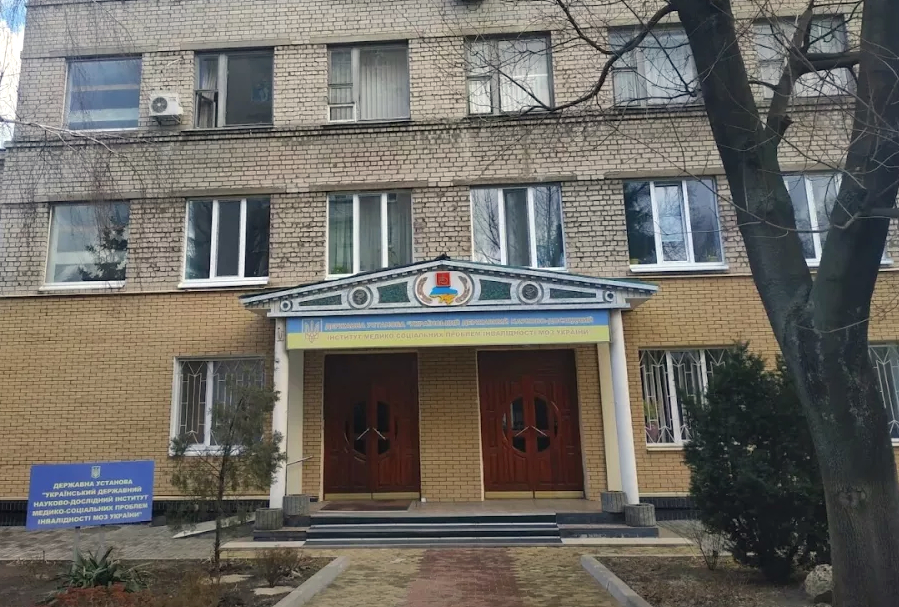
Ukrainian State Scientific Research Institute of Medical and Social Problems of Disabilities of the Ministry of Health, where Oleksii Luhovyi and his colleagues had to verify their disability
In case of Luhovyi, the experts determined that the pathology of his nervous and cardiovascular system “limits his life activity to a mild degree,” thus he doesn’t fit the requirements to the group II disability which he received in 2024 in the MSEC, headed by Tetiana Krupa. However, Yaroslav Dranovskyi, the judge of the Khmelnytskyi district administrative court, allowed the prosecutor’s claim and gave his disability status back. Now, the Institute is trying to appeal this decision.
In some cases, the Ukrainian State Scientific Research Institute of Medical and Social Problems of Disabilities abolished the resolutions on disability which had lost their validity. Several more prosecutors managed to appeal the resolution on abolishing the disability status due to contradictory decisions of experts and mistakes in the documents.
For instance, in case of prosecutor Oleh Shpak with foot paresis a neurological syndrome, characterized by weakness of muscles and prevents the movement of the front part of the foot and toes it turned out that in 2020, the same Scientific Research Institute already checked the validity of the MSEC resolution and found no violations at the time. Yet in 2025, the MSEC resolution was claimed invalid and his group II disability was changed to a milder group III. Judge Vadim Matushchak decided that these two resolutions contradict each other and abolished the latter.
Why did the Institute lose in court?
All the inspections of disability status were conducted based on the decision of the NSDC dated October 2024. This decision stated short periods to inspect the MSEC resolutions. So, it is quite possible that haste became the reason for several procedural mistakes, used by the prosecutors in court.
“The procedure of disability determination underwent considerable changes, it is complicated, the normative basis hasn’t been coordinated, there is no systemic connection, there are gaps. The decision of the NSDC, which became the formal reason to review [disability status], is valid since October 2024. Thus, the instruction for law enforcement bodies “to report back about the measures taken in a month” and chaotic imitation of activity overlapped with the absence of knowledge of new procedures, thus, mistakes are possible. Judging by court decisions, these mistakes are very gross: repeated review, no call/notification for a person. These requirements are clearly written in the procedure; not to follow them, one had to want not to follow them,” a lawyer, specializing in administrative law, explains to NGL.media.
In addition, previously, the representatives of the Institute constantly ignored the court proceedings and didn’t give any evidence to strengthen their position. Yet, this situation changed somewhat in spring of 2026, when the Khmelnytskyi district administrative court started taking the first decisions in favour of the Institute, not prosecutors.
As of now, there are only five such decisions. In their claims, the prosecutors stated the same procedural mistakes as their colleagues had done before. However, in these cases, the Ukrainian State Scientific Research Institute of Medical and Social Problems of Disabilities was active in court, provided explanations, and stood its grounds. For instance, the lawyers managed to convince the court that the Institute had reasons for inspections because they were conducted within the framework of the criminal case.
Also, in ten lost cases, the Institute appealed the court decisions, which shows some interest in the result and possibly indicates the initiation of a more active legal position.
The legal department of the Scientific Research Institute of Medical and Social Problems of Disabilities told NGL.media that sad statistics with administrative suits occurred due to the reorganization of the Institute itself and the absence of resources to work with a large number of court cases.
“In October 2024, we were transferred the authorities of the central MSEC, and since January 1 [of 2025] the centre of evaluating a person’s daily functioning started its work. A new system was created which has never worked in our institution. We needed time to go through all this turbulence and understand how to work with it,” Oleksandr Dovzhenko, the head of the legal department of the Institute, says.
Previously, Dovzhenko was the only lawyer in the institution. In his words, now they have created a division, where additional lawyers have been hired, and the Institute started winning suits more frequently. The analysis by NGL.media confirms this tendency: all five cases in which prosecutors didn’t manage to renew their disability status were recently viewed by the Khmelnytskyi district court, in spring of 2026. But it is not that unequivocal because during this period, the Institute also lost some cases.
At the end, it should be noted that among prosecutor’s office employees, there indeed are those whose health condition actually met the requirements to getting the disability status. The idea to inspect the resolutions of both Khmelnytsky MSEC and other potentially corrupted commissions was to confirm the status of those who needed it and to revoke it for those who received payments and benefits from the state without any reason.
Theoretically, the Scientific Research Institute of Medical and Social Problems of Disabilities could have conducted the repeated inspection of those prosecutors, whose suits it lost, but this time with adherence to all procedural requirements. Yet, it is really important to be more active in court proceedings – as evidenced by the first successful examples.
Author Kateryna Rodak, editor Oleh Onysko, infographics Maksym Piho, translation Nelya Plakhota, cover Viktoria Demchuk
This publication was produced as part of an IWPR project with financial support from Norway. The content of this publication is the sole responsibility of the NGL.media editorial team. This material can in no way be considered to reflect the position of IWPR or the Government of Norway.
