
The municipal enterprise of the Lviv city council commissioned a Kharkiv-based company, Intechengineering, owned by Mykhailo Tits, a founder of Russian companies for many years, to elaborate the draft for the renovation of some of the city’s wastewater facilities. His long-term business partner, Yurii Meshengisser, not only kept his Russian company after the beginning of the full-scale invasion, but also expanded its activity considerably.
The confidential technical information about the critical infrastructure of a city with a million of residents has practically ended up in the hands of people, closely connected to Russians, and, possibly, to the Russian security forces. And all this takes place against the background of Russian threats to destroy the critical infrastructure of Ukrainian cities.
NGL.media found out about this situation four months ago, but we delayed this publication at the request of the security forces, who also got interested in the agreements of the Lvivvodokanal [Lviv water services company]. During this period, we have found confirmations of the fact that the Lviv municipal utilities have repeatedly allowed questionable contractors to work – a large-scale draft project to build a biogas station in Lviv is being implemented by the company with long-standing ties, leading to Russia and Belarus.
Quality investigations require much time, efforts, and money. Join hundreds of participants of NGL.media community, who support this complicated work.
A company from Kharkiv, a plant near Moscow
Last year, the municipal enterprise of the Lviv city council, Lvivvodokanal, commissioned three draft projects to renovate aerotanks in the city’s wastewater treatment facilities Procurements here, here and here. Aerotanks are concrete reservoirs, filled with water from the sewage runoffs after its primary treatment. Practically, this is the very basis of the entire process of wastewater cleansing.
In all three cases, the winner was a private enterprise, Intechengineering, which received contracts for a total amount of UAH 8.2 mln. The company was registered in Kharkiv in 2018, and since then, it never took part in the state procurements. Three contracts from the Lvivvodokanal became the first budget-financed orders in the history of the company.
The director and owner of Intechengineering is Mykhailo Tits, a 70-year-old resident of Kharkiv, who has worked in the sphere of water disposal and wastewater treatment. He is still named as one of the cofounders of the Ukrainian consortium RPE Ecopolymer and was the deputy director of this company. Former employees of the Ecopolymer are mentioned among the current employees of the Intechengineering, for instance, the chief engineer, Denys Martynov.
RPE Ecopolymer has been simultaneously working both in Ukraine and in Russia for over 30 years. Practically, it was a joint Russian-Ukrainian consortium, and the Russian part of the Ecopolymer was much more powerful than its Ukrainian part. In fact, only designing engineers were working in Ukraine, and the plant, producing equipment for wastewater treatment facilities, worked in the Kaluga region of the RF. And it is still working there.
Different legal entities of the Ecopolymer were registered to separate the activity in Ukraine from that in Russia, although these two had the same founders – Mykhailo Tits, Valentyna Shchetinina, and Dmytro Halych. The main part of this business belonged to Yurii Meshengisser, a businessman from Kharkiv.
After the Russian invasion in 2022, the Ecopolymer seems to have started winding down its operations in Ukraine. The corporate website doesn’t work, social network accounts aren’t active, and the number of officially registered employees, according to the data of YouControl, decreased from 105 to four. Yet, officially the Ukrainian company hasn’t been dissolved yet.
On the contrary, the Ecopolymer does much better in Russia – for instance, in 2024, the company reported testing equipment in Lipetsk, and in 2025, it assembled equipment for wastewater treatment facilities in Krasnoyarsk. However, nowadays, the Russian branch of the Ecopolymer is ever more often working under the brand name of “My Project” – an affiliated company, which in 2022, together with the Ecopolymer, became a part of Polyplastic group of companies, owned by an influential Russian businessman, Miron Gorilovskyi According to the data of the Prosecutor General’s Office, the Polyplastic company was involved in the elaboration of composite materials, used to improve a small-arms sample at a request from the Ministry of Defence of Russia. In May 2023, the company was sanctioned by the NSDC, and a number of Ukrainian plants, which belonged to the Polyplastic group, were confiscated.
At the same time, Mykhailo Tits still remains the co-owner of two Russian companies of the Ecopolymer. As for Mykhailo Tits, he told NGL.media that since 2022, he is no longer a co-founder of any Russian companies, but the data from Russian registers prove otherwise.
A consortium master
70-year-old Yurii Meshengisser has been Mykhailo Tits’s business partner for many years. He still owns the largest shares in the Ukrainian Ecopolymer, as well as the Ukrainian LLC, Vokrug Tsveta [Around Colour] Publishing House.
In 2022, the Kyiv District Prosecutor’s Office in Kharkiv launched an investigation of the activity of companies, whose beneficiaries have Russian citizenship. Judging by the ruling of the Kyiv district court in Kharkiv, Yurii Meshengisser has Russian citizenship The court rulings state that the founder of RPF Ecopolymer, Ecopolymer LLC, and Vokrug Tsveta Publishing House LLC, the shares in which coincide with Meshengisser’s shares, has Russian citizenship.
The full-scale invasion had almost no impact on Meshengisser’s business in Russia. On the contrary, he even managed to expand it.
Prior to 2023, he was registered in Moscow as a sole entrepreneur, so he is still among the founders of the Russian publishing house, Vokrug Tsveta, which publishes a specialized journal, “Vodosnabzhenie i sanitarnaya tekhnika” [Water Supply and Sanitation Equipment].
Yurii Meshengisser still makes regular trips to Russia and takes part in public events. For instance, in September 2022, he visited the exhibition of water technologies, EcwaExpo 2022, in Moscow, in 2025, he was seen at the event of the Russian union, “Living Water Engineers”, and in 2026, again, he was present at a specialized exhibition.
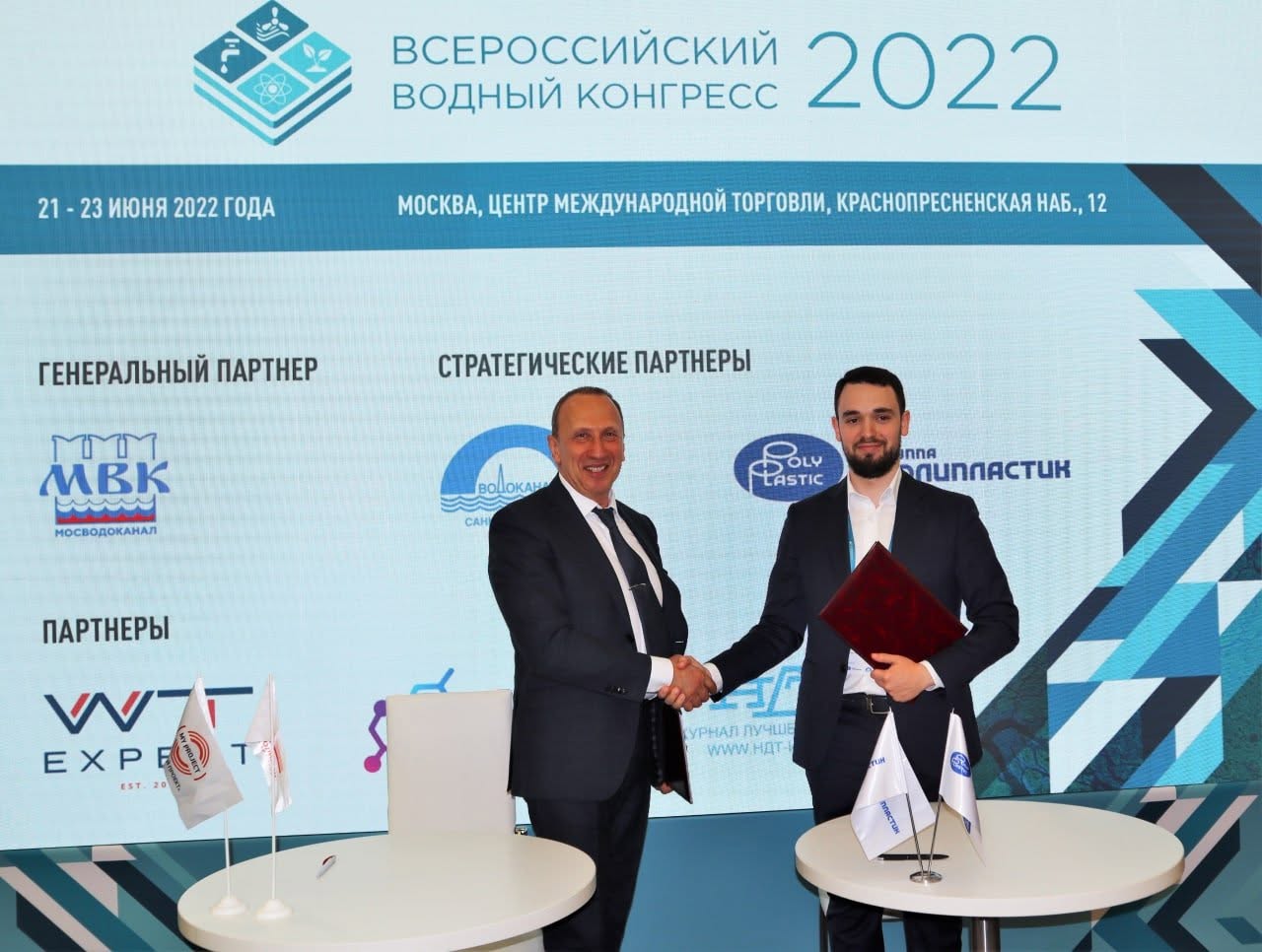
Yurii Meshengisser (on the left) during the VI All-Russian Water Congress, which took place in June 2022 in Moscow (a photo of the press service of the Russian company, Polyplastic)
NGL.media also managed to find out that Meshengisser not only headed the Russian-Ukrainian consortium, which regularly cooperated with the critical infrastructure of Russian and Ukrainian water utilities for many years, but also represented himself as a technical director of the Rosvodokanal group, which is a part of Alfa-Group a conglomerate of Russian and international companies, the main owner of which is Mykhailo Fridman, against whom Ukraine imposed personal sanctions, and is one of the largest water supply companies in Russia. Yurii Meshengisser didn’t respond to NGL.media’s request for comments.
Mykhailo Tits assured NGL.media that he doesn’t communicate with Yurii Meshengisser. He also claims that now he and his family live in the Lviv region, but he refused to meet the journalists personally. Judging by his social network accounts, at least in 2024, Mykhailo Tits lived in Switzerland and even participated in the events to support Ukraine. NGL.media didn’t find any confirmation to the fact that he had moved to the Lviv region.
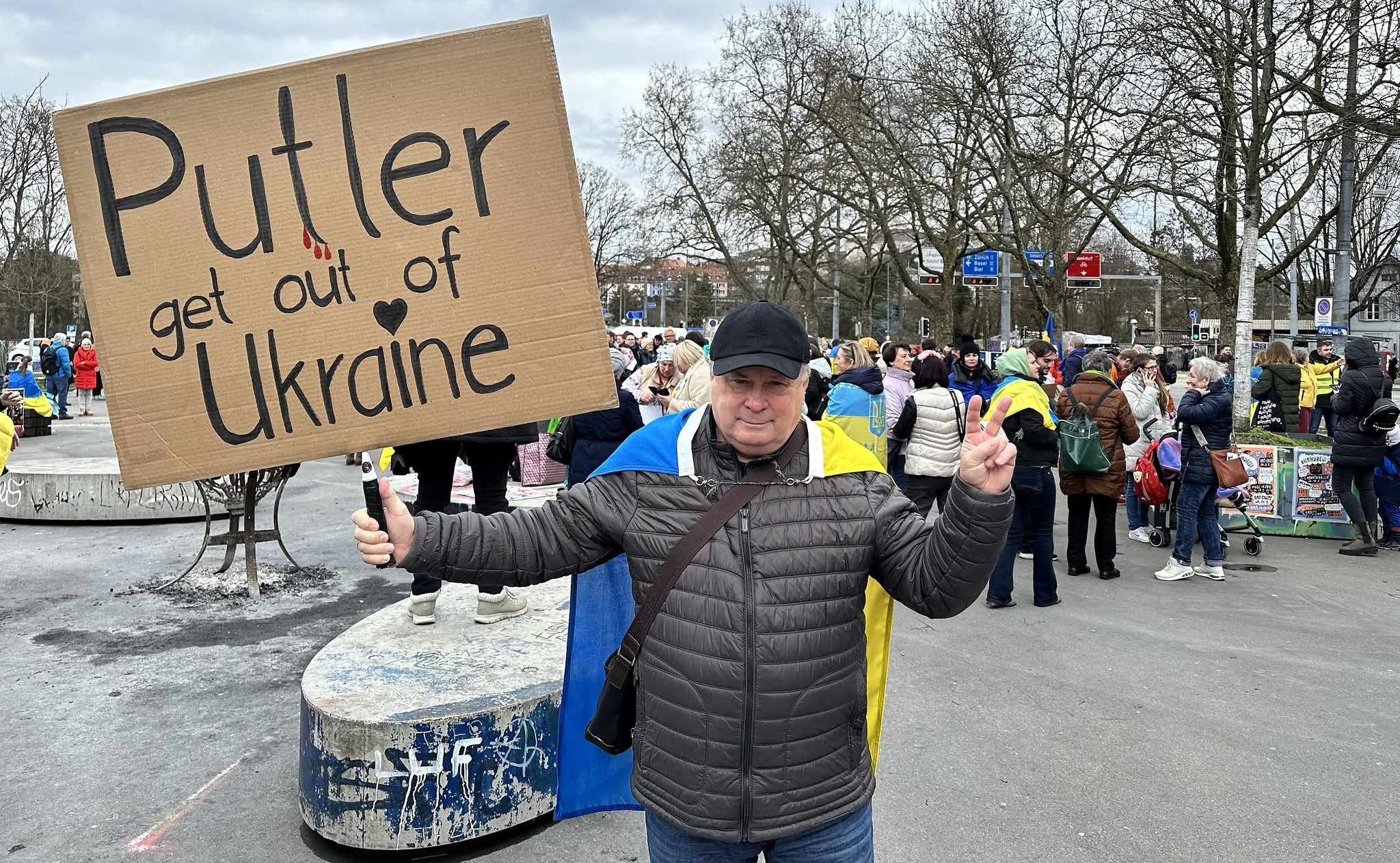
Mykhailo Tits is posing with the placard “Putin, go away from Ukraine” at a meeting in Swiss Bern, February 24, 2024 (a Facebook photo)
It is hard to believe that Mykhailo Tits doesn’t keep any relations with his close business partner. He regularly posts nostalgic photos on social network and videos from previous corporate parties of the Ecopolymer, in which he stands next to Yurii Meshengisser and his Russian business partners.
Mykhailo Tits (on the right) with Nikolai Furtaev, the director of the Russian My Project, at the corporate party of the Ecopolymer in 2015 in Kharkiv (a screenshot of the video)
Another contract for lovers of Russia and Belarus
Despite the fact that the Ecopolymer never officially cooperated with the Lvivvodokanal, the company demonstrated some interest in the Lviv wastewater treatment facilities in 2018. It is probable that the Ecopolymer wanted to participate in the ambitious project of building a biogas station in Lviv.
At approximately the same time, when the city council selected the Slovenian-Norwegian consortium RIKO-CAMBI, to be the contractor to build the biogas unit, Serhii Zbrokh, a former top manager of the Ecopolymer Serhii Zbrokh held top positions in the Ecopolymer for over eight years went to work for RIKO, where he headed the biogas project till 2023. Now, Serhii Zbrokh is a technical advisor of the NEFCO corporation in Ukraine, which co-finances construction. Serhii Zbrokh didn’t answer NGL.media’s questions.
Although RIKO company is registered in Slovenia, it worked in Russia and Belarus for many years. The contract with the Lvivvodokanal isn’t RIKO’s first contract in Ukraine but it is the largest one.
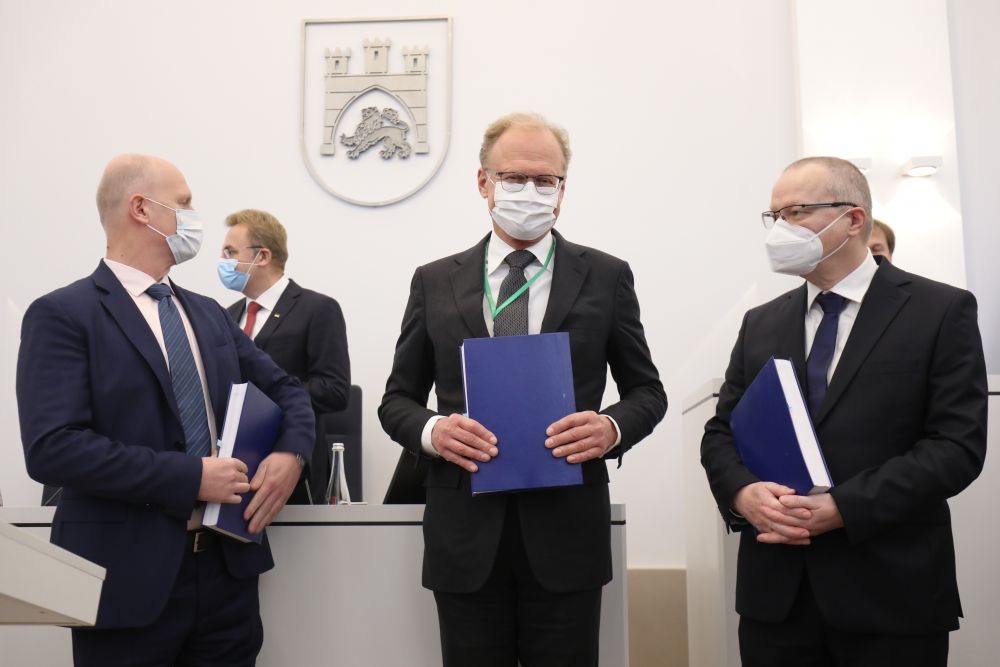
Janez Škrabec (in the centre) during the ceremony of signing the agreement with the Lvivvodokanal in the Lviv city council in December 2020 (a photo by Roman Baluk)
For many years of the operation in the Russian market, as far back as in 2009, Janez Škrabec, the founder of RIKO, was awarded one of the Russia’s highest state awards – the Order of Friendship, and in 2011, he headed the Slovenian-Russian business council. The independent Belarusian investigative journalists of the Buro project found out that in 2022-2023, RIKO and its Belarusian affiliate company still supplied equipment to the RF.
RIKO company has even stronger ties with Belarus. Since 2016, Janez Škrabec was an honorary consul of Belarus in Slovenia. In 2021, he lost this status due to the actions of President Lukashenko The consulate of Belarus in Slovenia was closed because of the scandal when the plane of the Ryanair company with Roman Protasevych, an oppositional Belarusian journalist, on board, had to land in Belarus on demand of the Belarusian authorities. At that time, the European Union closed the airspace to all the Belarusian airlines and the absence of Janez Škrabec’s proper reaction to these actions. He used to call Belarus his second motherland.
The company still works in Belarus and receives state orders. For instance, in 2023, RIKO built a substation in the Belarusian city of Grodno, and Janez Škrabec was present at the opening ceremony.
The investigators of the Buro project believe that Janez Škrabec is personally acquainted with Alexandr Lukashenko, and he often spoke against the EU’s sanctions against Belarus.
NGL.media asked the RIKO company for comments on the current projects in Russia and Belarus and on the contractors, working on the Lviv project, but we haven’t got any response as of the time of publication.
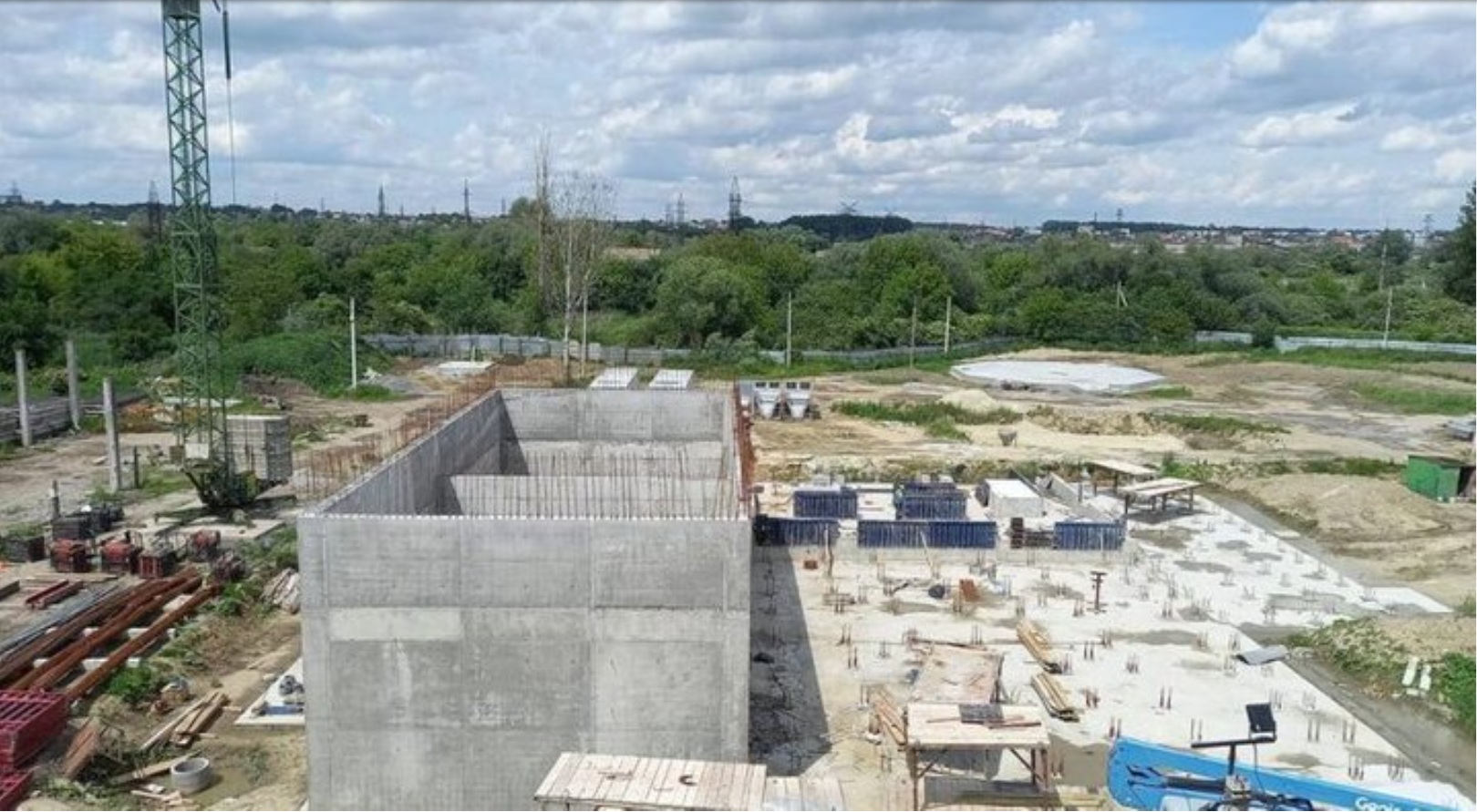
The state of the biogas unit construction in June 2025 (a photo by the Lviv city council); NGL.media couldn’t get a photo of the current state of the object due to the security prohibitions
The biogas station in the Lviv wastewater treatment facility hasn’t been put into operation yet, although the project was to be completed three years ago. During this period, its costs grew to EUR 41 mln. According to recent promises, they intend to have completed the station in 2027.
The Lviv city council didn’t respond to NGL.media’s questions for this article.
Who was supposed to check it all
It was early summer of 2026 when NGL.media found out about questionable Russian connections of the Intechengineering, to which the Lvivvodokanal practically submitted information about the critical city’s infrastructure, including all the maps and schemes of the wastewater treatment utilities. At the time, we contacted the Lviv city council and Dmytro Vankovych, the head of the Lvivvodokanal, to ask the relevant questions.
At first, the Lviv city council assured us that they were preparing their response to the inquiry and asked for some more time, but NGL.media hasn’t received any response yet. At approximately the same time, according to NGL.media’s data, this case attracted the interest of the specialists from the counterintelligence department of the SSU, who started investigating possible relations between the Intechengineering, Ecopolymer, RIKO corporation and the representatives of the Lviv city council.
The representatives of the SSU unofficially asked us to delay the publication of this investigation for at least two months, not to spook probable collaborators of Russians in Lviv. Yet, after this period, they stopped contact with NGL.media. The editorial office sent an official inquiry to the SSU.
A week and a half ago, the publication about possible Russian connections of the Intechengineering appeared on the local website, Tvoe misto. After that, Dmytro Vankovych, the director of the Lvivvodokanal, told NGL.media that the Russian business of Mykhailo Tits, the owner of the Intechengineering, took him by surprise.
“Our procurements take place according to the tender procedures in Prozorro. Everyone, who has a right to work in Ukraine and abroad, participates in them. Obviously, neither a Russian company, nor people related to it are allowed to take part. But it is beyond our scope of competence to investigate or know about it. There are special services for this task,” Dmytro Vankovych said.
However, it is the authorized employee of the client, the Lvivvodokanal in this case, who has to check the contractor’s documents. In October 2022, the government issued a resolution that prohibits the clients’ cooperation with citizens of Russia and Belarus, as well as legal entities, whose beneficiaries they are.
In addition, in 2022, Andrii Sadovyi, the Lviv mayor, asked the law enforcement bodies to pay attention to the companies, registered in Lviv, which belong to Russians directly or indirectly. And in June 2025, the city council even approved a special resolution, which ordered the executive bodies to check all the companies, coming to get some administrative services, in terms of their relations with Russia.
So, there were several legal norms that made it obligatory for the Lvivvodokanal to conduct more thorough checks on the company that would get the information, strategically relevant to the life of the city. To prepare the projects of aerotanks, the contractor would have to get the initial technical data about the infrastructure of all the wastewater treatment facilities.
In the words of the designing engineers NGL.media talked to, it is hard to destroy the wastewater treatment facilities with a direct strike, if one doesn’t know what exactly to target – but detailed documents about the object make this task much easier. This carefree attitude of the municipal enterprise to the critical infrastructure of the city, against the background of regular threats and direct strikes on water utilities in other cities, seems to amount to at least a dereliction of one’s duty.
