
In the past four years, Ukraine received almost two hundred cogeneration units from our international partners, which should have mitigated the consequences of the regular destruction of energy infrastructure by the Russians. The supplier of almost all these units, distributed among different Ukrainian cities free of charge, was the United States Agency for International Development (USAID), which terminated its activity in 2025 This equipment came to Ukraine within the framework of the Energy Security Project, implemented from 2018 to 2025. At the end of last March, the US Department of State announced the dissolution of the USAID and termination of all its current projects.
Most of these cogeneration units (CGU) were transferred to the account of local district heating providers to generate electricity and heat during power system blackouts. Some of them did play their role, especially during this hard winter.
However, the analysis by NGL.media demonstrates that over 40% of the cogeneration units, transferred by the Americans, haven’t come into operation yet. The scale of this despicable situation varies depending on the region, but there are at least two common reasons: money and specialists.
NGL.media decided to use two neighbouring towns in the Zhytomyr region to illustrate why some people succeeded in utilizing this aid and spent winter in relative warmth, while others didn’t.
The story of Berdychiv
Most residents of Berdychiv, a town of 70 thousand, receive their heating from the local municipal enterprise, Berdychivteplokomunenerho. When, in February, Olha Shalai received her January bill, she was surprised, to put it mildly.
“Due to power cuts, there was no heating, what am I supposed to pay for?” she complained in the local Facebook group. She was supported by many other residents.
Actually, Berdychivteplokomunenerho could have fully provided its clients with heating services, if it had managed to hook up the backup power supplies. In the last two years, Berdychiv has received five CGUs with a total capacity of 1.24 MW, which allows it to meet 40% of the municipal needs during peak heating-season loads. Yet, neither of these five units has come into operation.
“We physically lacked finances. We made a hookup project, we cemented the foundations for the CGU. We took a loan for UAH 13 mln to procure the soft start switches and cables,” Serhii Pryimak, the director of ME Berdychivteplokomunenerho, justifies himself in the conversation with NGL.media. “However, it turned out that hooking up gas requires the insertion of specific feed units, which cost millions of hryvnia. Our finances were enough to pay for only one of these feed units. At this point, the process was put on the brakes.”
Last November, Serhii Pryimak asked the town council to allocate UAH 2.3 mln for installing gas feed units. In his words, the money was promised for February. At present, the enterprise has already spent UAH 15.6 mln, together with the loan, yet there is no working CGU in the town.
A relevant detail: in June 2025, the police detained Serhii Orliuk, the mayor of Berdychiv, on suspicion of bribery. He is still under investigation and refused to give NGL.media any comments.
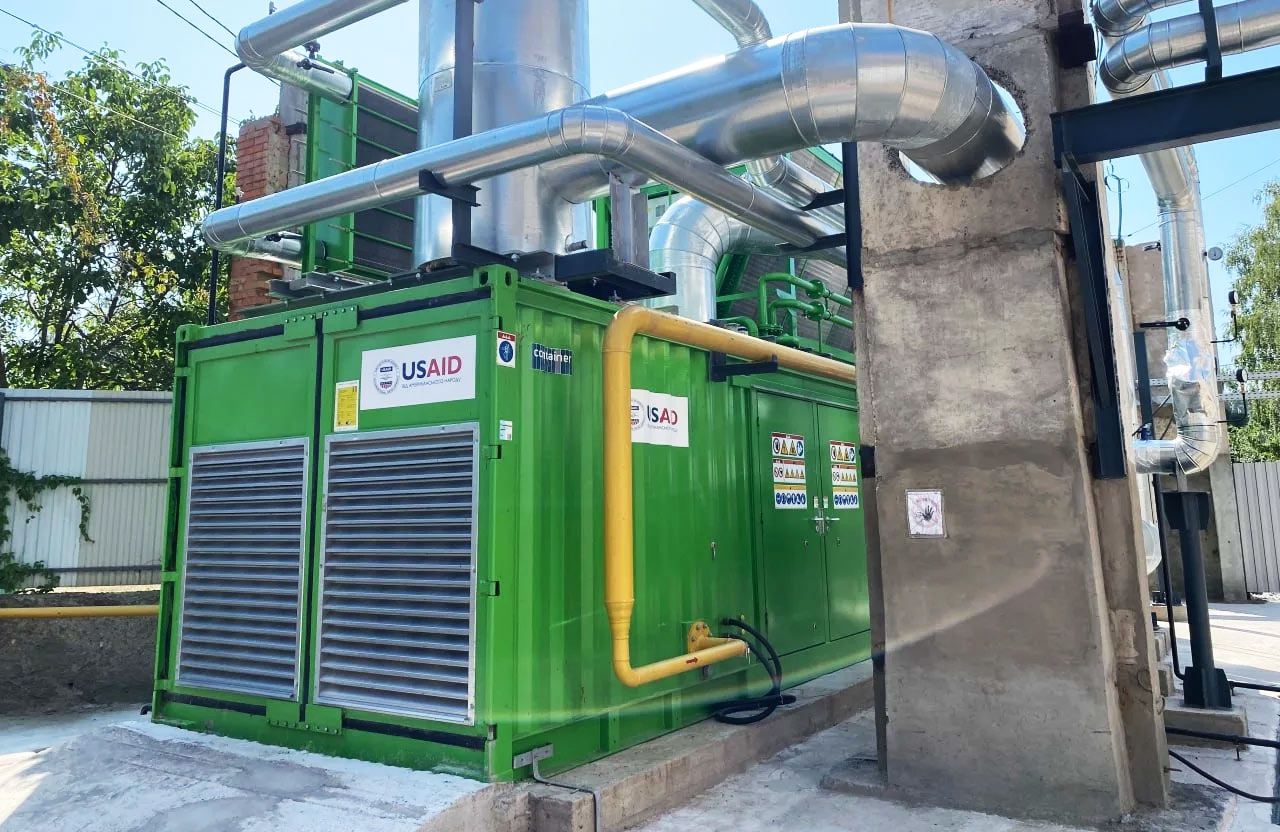
One of the gas reciprocating units, transferred within the framework of the USAID project and put into operation in Poltava (a photo by the Poltava city council)
The example of Zviahel
100 km from Berdychiv by air-line, there is one more town of 50 thousand residents, Zviahel The historical name of the town, restored in 2022, previously called Novohrad-Volynskyi, where two CGUs with the capacity of 260 kW work successfully. At the end of December 2024, the local ME Zviahelteplo received the first unit from the USAID, and last June – the second one.
“We had no difficulties. In early November 2025, we launched these units. We spent almost UAH 3 mln for the installation and the design estimates, UAH 1.6 mln of which were given from the local budget, and the rest was financed by our ME,” Liudmyla Todorovych, the director of Zviahelteplo, told NGL.media. The capacity of two CGUs covers about a quarter of the enterprise needs for electricity during the heating season.
In Liudmyla Todorovych’s words, she knows about the situation in Berdychiv and even asked them to transfer the units, that have not been hooked up, to Zviahel.
“We would love to install four more units. We see that the status of the districts with no breaks in heating supply goes up, people are asking, “Why do they have heating and we don’t?” Because they have a CGU, power cuts don’t affect the provision of the heating,” the director of ME Zviahelteplo explains.
Can a CGU replace a thermal power plant (TPP)?
To have a better understanding of the difficulties faced by communities while installing CGUs, one should explain how it generally works.
So, a cogeneration unit (CGU) is equipment for simultaneous generation of electric and heating energy from the same kind of fuel All the units, transferred by the USAID, work with gas, so they are also called gas reciprocating units. To put it simply, one can say that this is a large city generator that produces electricity and also heats water. However, the main demand of most communities is the generation of electricity, heating is used as an additional effect of the unit work.
The CGU must be connected to the municipal networks (gas, water, electricity) and pipelines to supply the heat carrier to consumers. Sometimes, these units are called mini-TPP. It is important to realize that CGUs cannot replace TPP completely, as their capacity is much lower.
In the words of Sviatoslav Pavliuk, the executive director of the Association “Energy Efficient Cities of Ukraine”, the advantage of cogeneration lies in the fact that it can quickly take up the load in case of emergencies or attacks, thus ensuring the resilience of the power system.
“For instance, nuclear energy is basic and doesn’t leave any room for manoeuvres. The reactor constantly gives the intended amount of energy. But when there are fluctuations in consumption, one needs fast reaction means: battery modules or cogeneration units. We always lacked manoeuvres in terms of cogeneration, so the more of it we have, the better,” Sviatoslav Pavliuk believes.
Bureaucratic marathon
Another reason for the long initiation of the CGU is the requirement that the utilities should collect dozens of documents. In the words of Serhii Pinchuk, the senior advisor for the Association of Operators of Critical Infrastructure of Ukraine, the donors transfer the units to the communities only at their request in accordance with the capacity, ordered by them.
“One should start preparing projects only after the donor has given the information on which exactly unit, of which capacity, and manufacturer has already been procured for the community. Once the community receives the technical passport for the CGU, they can start preparing the installation project,” Serhii Pinchuk explains.
The project development is the responsibility of the municipal enterprise to which the CGU was transferred. Most communities announced the open bidding and looked for a contractor for the project.
To develop the project, the contractor has to provide technical conditions Documents from the network operators, defining the conditions and the way in which the unit may be hooked up to the electricity, gas, and heating network, the preparation and issuance of which can also take a few weeks.
“The implementation of work for the CGU installation may take a few months. To facilitate the process, many enterprises divided their projects into parts. For instance, once they did a part of the project regarding the foundation, they cemented one, once they got the permit to hook up to the heating network and did this part of the project, they hooked it up. It saves time for the installation considerably,” Serhii Pinchuk says.
In the words of the expert, each community has a different project, since they have to consider a lot of technical specificities: the place of CGU installation, distances to electricity and gas networks, sets of materials and equipment for installation and hooking up to the networks, etc. For instance, the process of installing open units is much longer and more expensive than that for the container-type units. There are cases when cities hooked up the units in two to three months, but in others, the process takes years. It is impacted by both technical and financial factors, as well as human resources issues.
“For instance, the last stage of work is the coming of the producer’s representatives, who inspect everything and launch the unit. Sometimes, one has to wait for them for over a month, too. The launching itself may take from several days to a week,” the expert explains.
Is it hooked up? Have millions ready to maintain it.
In addition to the installation of units, they have to be maintained, which is not cheap either. For instance, Lviv received eight gas reciprocating units for the total cost of UAH 122 mln. The city budget spent UAH 55.3 mln for their mere installation.
“We also executed agreements for servicing of all eight units, transferred to the city, for the total amount of UAH 12.1 mln a year. This was the requirement from the producers of the CGUs bought for us,” Oleksandr Odynets, the director of Lvivteploenergo, told NGL.media.
As of February 2026, five out of eight CGUs work in Lviv, two more are at the stage of start-up work, and in one location, the building works are coming to their completion.
How many CGUs have actually been put into operation
According to the information from the Ministry of Development, provided to NGL.media, USAID gave a total of 188 cogeneration units. However, the Ministry refused to give detailed information in terms of regions and the number of non-operating CGUs.
So, NGL.edia sent inquiries to all regional military administrations and received responses from all regions except Ternopil and Sumy. As a result, we collected information on 137 CGUs received in 2022-2025. According to the data from the RMA, only 59% CGUs have been put into operation, and the rest have not.
Mykola Kolomyichenko, the energy specialist and former member of the board of the State Agency on Energy Efficiency and Energy Saving, believes that actually less than 50% of the CGUs have been launched.
Putting into operation envisages the installation of the cogeneration unit and hooking it up, but it doesn’t mean that it is being used,” Mykola Kolomyichenko explained his idea to NGL.media. “There are different reasons for its not being used: there is no stable heating load, the cost of gas is high, there is no economic model for the electricity sale, there are problems with modes and automation, there is no trained personnel and servicing.”
Together with several people’s deputies, Kolomyichenko addressed Yulia Svyrydenko, the prime minister, requesting detailed information on the actual state of cogeneration, but has not yet received a response.
In his expert opinion, the Ministry of Energy should have established a department with engineers who could develop the installation standard and help cities implement it. Instead, all the difficulties are shouldered by the heating enterprises that received the CGUs.
“Actually, nobody knows how many of them really work, because nobody carried out any audit. In each case, it is important to check whether the gas network is capable of providing the required amount of gas and whether the substation can accept this heating. These issues have not been evaluated at all…” Kolomyichenko says.
Mariana Verbovska, editor Oleh Onysko, infographics Maksym Piho, translation Nelya Plakhota, AI-generated cover
