
At the end of last October, Joe Barnes, a British journalist, published astonishing figures in his article in The Telegraph: in merely two months, almost 100 thousand young Ukrainians, aged 18-22, had fled Ukraine via the Ukrainian-Polish border. Later, the Polish border guards called this figure a gross exaggeration, because it covered neither those who came back nor multiple border crossings.
Indeed, there is a tendency among young people to leave Ukraine, including minors. The permission for young men, aged 18-22, to leave the country actually did provoke a wave of emigration, although it wasn’t on such a large scale. Last September-November, about 78 thousand young Ukrainians really left the country.
However, the total scale of draft-age men, fleeing Ukraine, is much larger. According to the estimates of NGL.media, based on the data about border crossings, since the beginning of the full-scale war, about 470 thousand men legally left Ukraine and didn’t come back, and at least 70 thousand more crossed the border illegally.
How did we do our math?
Unfortunately, the State Border Guard Service of Ukraine maintains only total statistics of border crossings, without any breakdown by age or gender. Therefore, NGL.media contacted the border guards of the neighbouring countries – Poland, Romania, Slovakia, Moldova, and Hungary All the checkpoints at the border with Belarus and Russia are officially closed since February 2022. We asked them for monthly data about border crossings by male Ukrainian citizens, aged 18-60, starting from February 24, 2022 to November 2025 inclusive. We also asked for the data on registered cases of illegal border crossings beyond the official checkpoints.
It is essential to understand that the data about entry/exit don’t equal the actual number of men. If the same person crosses the border there and back several times, each crossing is registered separately. For instance, Sviatoslav Litynskyi, a volunteer from Lviv, crossed the Ukrainian-Polish border 70 times within the mentioned period. So the impersonal data, used by us below, are always much higher than the number of people who actually crossed the border.
However, these impersonal data allow us to evaluate the actual number of men who crossed the border legally but didn’t come back to Ukraine. For instance, if the neighbouring country registers 50 thousand entries from Ukraine over a long period of time, and only 35 thousand go back, it means that 15 thousand Ukrainians remain abroad. Obviously, some of them could have come back via another country (and there are many such cases), but the cumulative statistics of all the neighbouring countries allow for rather an accurate evaluation of the number of non-returnees.
NGL.media received and analysed detailed data, received from Poland, Romania, Slovakia, and Moldova, on border crossings by Ukrainian men. Unfortunately, the border guards of Hungary refused to cooperate, which surely impacted the final results, although not by much.
What did we see?
Most often, Ukrainian men flee to Poland. It is not too surprising since almost half of all the transborder passenger flow goes through this country. However, according to data from the State Border Guard Service of Poland (Straż Graniczna), the difference between entries and exits is only 2.6%. In absolute terms, this is about almost 188 thousand Ukrainian men, aged 18-60, who left since the beginning of the full-scale war and didn’t come back. This figure also covers about 60 thousand young male Ukrainians, aged 18-22, who left in September-November 2025.
On the contrary, the total number of border crossings with Moldova and Romania is much lower, but the difference between entries/exits is 10.6 and 13.7%, respectively. The negative balance of Ukrainian emigration via these two countries is about 342 thousand men.
These losses are partially compensated by Slovakia, where an atypical situation is observed: more men return to Ukraine than leave it. Probably, this is the border via which some Ukrainians, who left via other countries, come back to Ukraine. This tendency is observed throughout the war, except in September 2025, when the difference between entries/exits was 0.5%. It is obviously related to the permission for male Ukrainians aged 18-22 to leave, which was issued by the Ukrainian government in late August. Yet, in October-November, again, more men returned to Ukraine via the Slovak border than left.
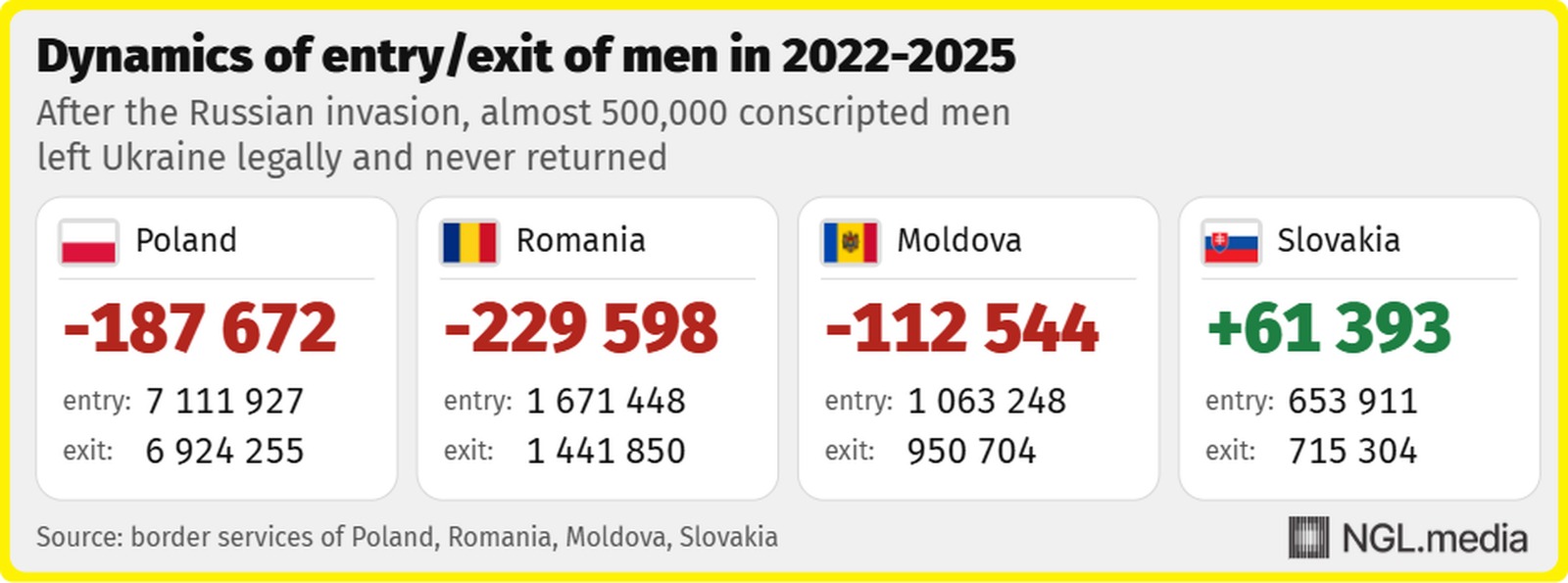
Unfortunately, the National Police of Hungary (Rendőrség) refused to provide NGL.media with the statistics about border crossings by Ukrainian men. The central statistics service of this country publishes the migration data without any breakdown by age or place of border crossing. In addition, these data may be incomplete. According to Hungarian statistics, in 2022-2024, only 5.8 thousand Ukrainian men aged 20 entered Hungary, and 16.7 thousand returned to Ukraine. These figures are too low to be true. For instance, according to the State Border Guard Service, during the war, Ukrainians of both genders crossed the Ukrainian-Hungarian border in both directions more than 14.4 mln times – almost twice as many as at the border with Slovakia.
By minimal estimates, if the exit via Hungary is not considered, the total number of draft-age Ukrainians, who left the country legally during the war and didn’t come back, is about 470 thousand people. Surely, this figure doesn’t cover the ones who crossed the border illegally (more about it below).
So, the actual number of men, who left Ukraine during the war, may be higher, but the question remains – how much higher. According to the data of the Eurostat, in 2022-2024, temporary protection in the EU member states was granted to about 1.1 mln Ukrainian men The dataset of the Eurostat covers two age ranges – 18-34 and 34-64. So, the figure of 1.1 mln people covers Ukrainian men, aged 60-64, with no restrictions to leave Ukraine. Besides, these statistics don’t include the data from Hungary since this country doesn’t provide it to the Eurostat. So, the Eurostat data may be viewed as something close to reality, but also approximate – and it is at least twice as high compared to the data of the border guards in Ukraine’s neighbours. This figure also includes the men who had previously gone to EU member states and only turned up for temporary protection after the full-scale Russian invasion.
“Although temporary protection should have been given only to those who came to the EU since February 24, 2022, it could have been granted to those who came prior to the full-scale war as well. The European Commission allowed the countries to solve this issue on their own. And the share of such permissions is hardly high, since most citizens came to the EU in March 2022, after the beginning of the full-scale war,” Iryna Ippolitova, the senior researcher of the Centre for Economic Strategy, explains. “Those with sufficient grounds and visas for long-term staying often got their visas prolonged automatically and didn’t need any temporary protection. However, in some cases, for instance, in Ireland, one could obtain temporary protection only after the visa expired.”
Illegal schemes
In addition to numerous reasons for official leaving The rules for the departure of draft-age men are specified in a separate resolution of the Cabinet of Ministers. These are mostly long-distance truck drivers, sailors, volunteers, active servicemen on leave or in need of treatment, men with many children, or the ones accompanying people with disabilities. Some legal grounds to cross the border may become the grounds for abuse: fictitious divorce and registration of foster care for children, marriage with a disabled woman, etc., different illegal schemes flourish in Ukraine. During the war, Ukrainian border guards detained more than 50 thousand men for attempting to cross the border illegally.
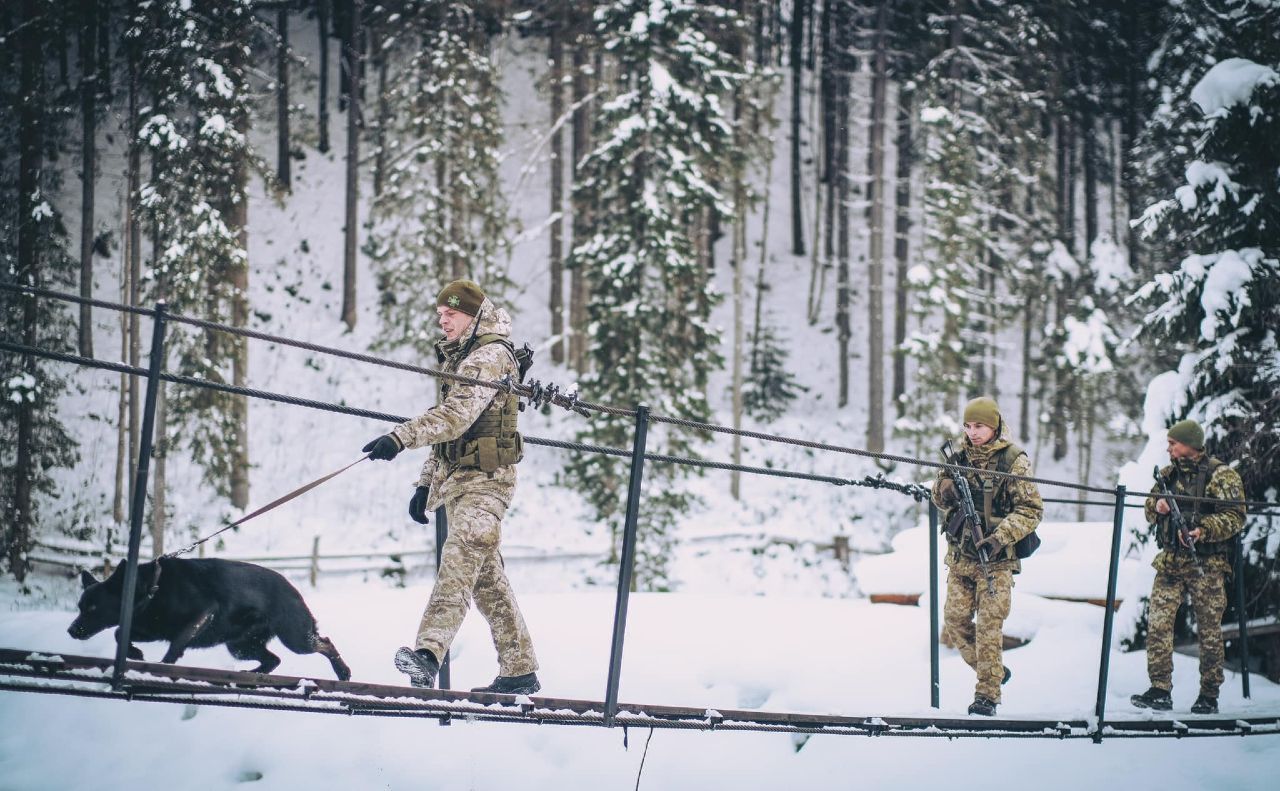
Photo. The patrol of Ukrainian border guards in the Carpathians (a photo by Media Centre Ukraine)
Some of them drown themselves in the Tysa or die in high areas of the Carpathians, yet many manage to cross the border via arranged smuggling routes. A typical example is the story of Valerii Husak, a 53-year-old businessman from Rivne, who was transported by a smugglers’ boat across the Tysa for USD 10 thousand.
According to the data of the State Border Guard Service of Ukraine, the most frequent attempts to cross the border illegally are made at the borders with Romania and Moldova. The Romanian border police told NGL.media that, on entering the Romanian territory, Ukrainian illegal immigrants go to the border guards on their own and ask for temporary protection.
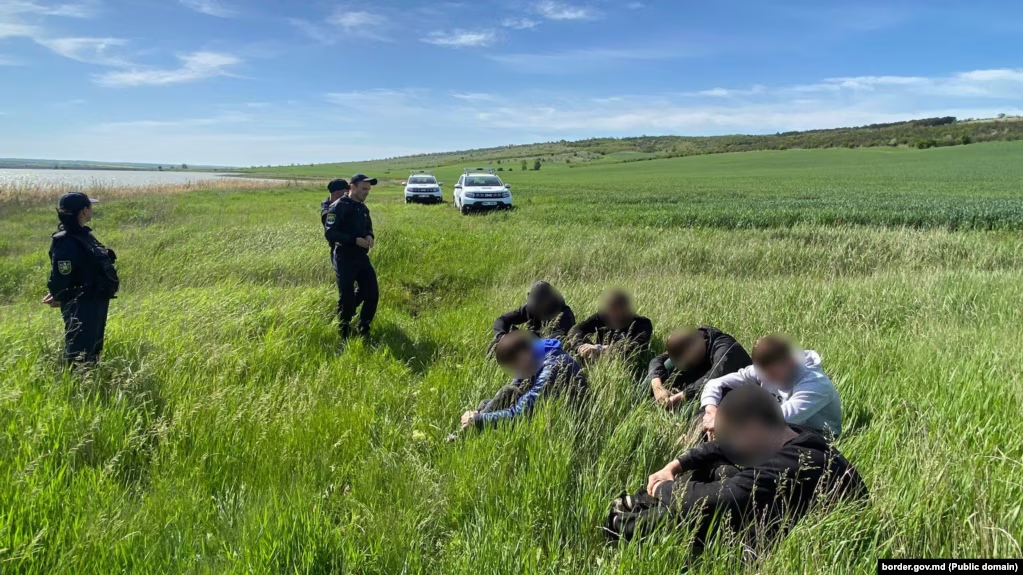
Moldavian border guards detain a group of illegal Ukrainian immigrants after the border crossing (a photo by Poliţia de Frontieră a Republicii Moldova)
After checking, these illegal immigrants are registered in the European biometric database, Eurodac. Then, the relevant migration services of the countries they entered deal with them.
The data of the Eurodac system are closed, but the relevant services of several neighbouring countries told NGL.media about the detected Ukrainian men, who came illegally. The highest number – more than 31 thousand cases of illegal border crossing – was registered by Romanian border guards. Much fewer illegal immigrants are found in Slovakia (3,951 cases) and Poland (1,203 cases). Hungary and Moldova haven’t provided any data, yet, considering the border length and popularity of these directions among illegal immigrants, the total number of runaways to these two countries can be estimated as 30-35 thousand men.
So, the total number of Ukrainians, who crossed the border illegally since the beginning of the war, is about 70 thousand men, according to guarded estimates. Added to those who left via official checkpoints, this number grows to 540 thousand men.
Recently, one more unexpected route has become popular – via Belarus. Only last year, Ukrainian border guards detained more than 1,400 illegal immigrants in this section of the border, which is four times higher than in 2024.
Officially, Ukraine prohibited crossing the Ukrainian-Belorussian border since February 2022, but according to the data of the state border guard committee of Belarus, as of the middle of last year, this border was crossed by 16 thousand Ukrainians of both genders.
What about men aged 18-22?
At the end of last August, the Ukrainian government allowed men aged 18-22 to leave the country. It actually affected the migration statistics, though not as critically as it seemed at first.
According to the data of Polish border guards, in three months of the validity of this permission, more than 120 thousand young Ukrainians went to Poland, but over 60 thousand of them came back to Ukraine. As expected, the largest wave of leaving was registered in September, in the months that followed the excitement went down.
During the same three months of last year, almost 44 thousand boys went to Romania (almost 27.5 thousand came back), and 10 thousand more went to Slovakia (almost 8.3 thousand came back). Hungary and Moldova haven’t given any detailed data.
So, during the three months after the permission to leave Ukraine, about 78 thousand men, aged 18-22, left Ukraine and didn’t come back.
“Some of them come back soon, because they see that they are not capable of achieving their aims abroad. Many are like that. And some leave to get an education, to work for some time, to save some money. And we will get some of them back in about 5-15 years,” Andrii Haidutskyi, migration researcher, says in the conversation with NGL.media. In his opinion, safety and economic situation are the main reasons why young men leave Ukraine now.
Ukrainian employers feel the consequences of this tendency too. In September, when the borders were opened for men, aged 18-22, Work.ua platform conducted a survey and asked about 1,000 employers about the consequences of opening borders. It turned out that one-third of the respondents felt a workforce drain, one way or another, mostly in the Horeca business, where many young people usually work.
Author Kateryna Rodak, infographics Maksym Piho, editor Oleh Onysko, translation Nelya Plakhota, cover Viktoria Demchuk
