
The basic monthly salary of a Ukrainian judge is within UAH 63 to 157 thousand as of March 2006: judges of local courts – UAH 63,060; judges of courts of appeal and the High Anti-Corruption Court – UAH 105,100; judges of the Supreme Court – UAH 157,650 – this is the bare minimum of the salary. However, the real payments are usually much – two or three times – higher. For instance, in 2024, the average monthly remuneration of a judge of the local general court was UAH 107.8 thousand, in administrative and economic courts, they are paid UAH 121.5 thousand, and the judges of the courts of appeal receive UAH 234.7 thousand on average the report of the SJA. The secret lies in extra payments for their service record, for an additional position, for knowledge of foreign languages, and for a scientific degree.
As a result, one in five Ukrainian judges is a certified scientist – a PhD or Doctor of Law. At the same time, the quality of their scientific papers raises doubts of independent experts, and their texts often turn out to contain plagiarism.
NGL.media found out the judges of which courts defended their theses most often and thus receive extra payments for their scientific degrees. We also studied the violations, previously found in the judges’ dissertations by the Public Integrity Council The Public Integrity Council (PIC) is a permanent independent body in the judicial system, intended to support the High Qualification Commission of Judges (HQCJ) in determining the compliance of a judge (a candidate for the position of a judge) with the criteria of professional ethics and integrity during the qualification evaluation. The status and authority of the PIC are defined in the Law “On the Judicial System and Status of Judges”.. The results demonstrate serious problems with adherence to academic integrity in the judges’ scientific papers. And these cost the Ukrainian budget a lot.
How did we count judges-scientists?
To find out how many judges have a scientific degree and how much they receive in additional payments for it, NGL.media made an inquiry to the State Judicial Administration, which, in its turn, distributed it to its territorial departments and economic, administrative courts, and courts of appeal, as well as to the Supreme Court and the HQCJ. We received a total of 108 responses. Within the specified period, the responses were not provided by the territorial departments of the SJA in Dnipropetrovsk, Ivano-Frankivsk, and Mykolayiv regions, the Economic court of the Donetsk region, and the Kyiv court of appeal. The Khmelnytskyi district administrative court refused to give a response twice, so NGL.media filed a complaint with the Office of the Commissioner for Human Rights at the Verkhovna Rada, and we are waiting for its consideration.
It was found that a total of 916 judges with scientific degrees work in Ukraine. Having defended their PhD the first scientific degree, since 2021, Doctor of Philosophy or doctorate thesis, they receive a monthly 15% or 20% payment, respectively, in addition to their salary.
In general, almost 20% from the total number of judges have a scientific degree As of March 2026, there are 4,767 judges in Ukraine, the data of the HQCJ. The highest share of scientists, over 65%, was found in the Supreme Court – 96 out of 146 judges. About UAH 30 mln are spent on additional payments to them every year.
Last year, the additional payments for scientific degrees of judges cost the Ukrainian budget at least UAH 123 mln, and in the last four years, the total amount was almost UAH 490 mln.
The additional payments are made to the judges of the court, liquidated a long time ago
Last year, over UAH 2.3 mln of additional payments for scientific degrees were received by the judges of the District Administrative Court in the city of Kyiv (DACK), which was liquidated as far back as December 2022. These judges don’t administer justice, yet formally, they keep their positions until they pass the qualification evaluation. Only then can they be either dismissed or transferred to another court.
A total of 18 judges of the DACK still receive additional payments for their scientific degrees. Among these, there is Maryna Boyaryntseva, who allegedly was named in “Vovk’s tapes” as well In 2019, Boyaryntseva and 33 more of her colleagues didn’t come to the exam in the HQCJ. The disclosed documents show that this non-attendance was coordinated by the judges following the recommendation of Pavlo Vovk, the ex-chairman of the liquidated DACK, with the purpose of circumventing the qualification evaluation of this court. Boyaryntseva failed the qualification evaluation, so she is facing dismissal.
One of the issues, raised during the interview within her qualification evaluation, was her scientific activity. The PIC found out that in her dissertation, the judge copied extracts from someone’s scientific papers without any referencing. During the interview, Boyaryntseva didn’t answer the question about the drawbacks, detected in the dissertation, just insisted that she “deserved respect for her professional and scientific life and her publications”.
The additional payments are also made to Kostiantyn Kobylianskyi, another judge of the liquidated DACK, whose dissertation was also found to contain plagiarism. The PIC detected that he literally used large extracts from the article of his scientific advisor, Serhii Kivalov.
But the DACK is not the only court, in which judges used plagiarism in their scientific papers. The violations in judges’ dissertations are common practice.
Where does plagiarism come from?
In the last ten years, 1,208 Ukrainians defended their doctoral theses in Law, and 4,929 more defended their PhD theses and became Doctors of Philosophy.
Prior to the defence, the dissertations should have been reviewed for compliance with the requirements of academic integrity several times. This is a set of ethical principles and defined rules for scientists to follow. Art. 42 of the Law “On Education” says that violations of the principle of academic integrity include cheating, bribery, falsification of data, plagiarism, etc.
Last December, the Verkhovna Rada even adopted a special Law “On Academic Integrity”, which is to come into force in June. Among other things, this law envisages punishment for violating the integrity principles.
“We are even the only ones in the world to have the Law ‘On Academic Integrity’. Just imagine: our problems in Ukraine are so extensive that we had to adopt a specific law!” Svitlana Blahodietielieva-Vovk, the head of “Dissergate” civil initiative, says. Together with her colleagues, she has been checking scientific papers for ten years.
In her words, not all the recipients of scientific degrees are proper scientists. These are often ordinary officials, using a degree just for the sake of benefits, including some payments in addition to the salary.
“A scientific degree is a very pragmatic thing. Firstly, you enter the ranks of the intellectual elite in any case. Secondly, you receive an economic benefit. And, thirdly, after a career in the state service, a person can become a university teacher,” Svitlana Blahodietielieva-Vovk explains.
Demand drives supply, and there appear networks, willing to close their eyes to plagiarism and prepare a dissertation “on a turn-key basis”.
“I call them toxic networks of scientists, which allow obtaining scientific degrees and titles for the corresponding payment or services. First of all, these are rectors, heading universities. They have students who defended their theses, have their degrees. And these are the ones to write these dissertations,” the head of “Dissergate” tells.
In her words, there are more than half a hundred such unfair rectors in Ukraine. As a result, each year, the state budget gives billions of hryvnia in additional payments for scientific degrees to those who should not receive them.
“In 2018, we started investigating all these toxic networks and estimated that at that time the additional payments for fakes amounted to about UAH 4.5 bln. I think this amount is much larger now – UAH 10-12, maybe, 15 bln are wasted for all these fakes each year,” Svitlana Blahodietielieva-Vovk assumes.
How common is plagiarism in the dissertations of judges?
Since last year, “Dissergate” started checking the dissertations of judges on a regular basis. They do it in cooperation with the PIC in the process of the competition for the courts of appeal and the qualification evaluation of judges. The results of their joint work have become evident immediately – 30 out of 34 negative reports on a judge/candidate, listing absence of their academic integrity, have been published in 2025–2026.
“Usually, we state only gross violations in the reports, including plagiarism in scientific conclusions of articles or dissertations, which should have been their own scientific achievement. Or this is “complete” plagiarism in the main part, when several pages in a row are stolen from someone’s work,” Anton Zelinskyi, a PIC member, says.
However, the HQCJ doesn’t always take the conclusions of the PIC into consideration. “The HQCJ subtracts the points but I cannot tell you any cases when a person failed the evaluation only due to violating the academic integrity. At present, this is rather one of indicators, creating the general impression about a candidate or a judge,” Zelinskyi explains, who has been working with the PIC for the third year.
It is noteworthy that the very members of the HQCJ, who are to evaluate others, were caught violating academic integrity too. Last April, the NABU accused Volodymyr Luhanskyi, a member of the HQCJ, of receiving UAH 500 thousand for a non-existent scientific degree. In 2011, he received a PhD degree in the Interregional Academy of Personnel Management (IAPM) which didn’t have the authority to grant him one.
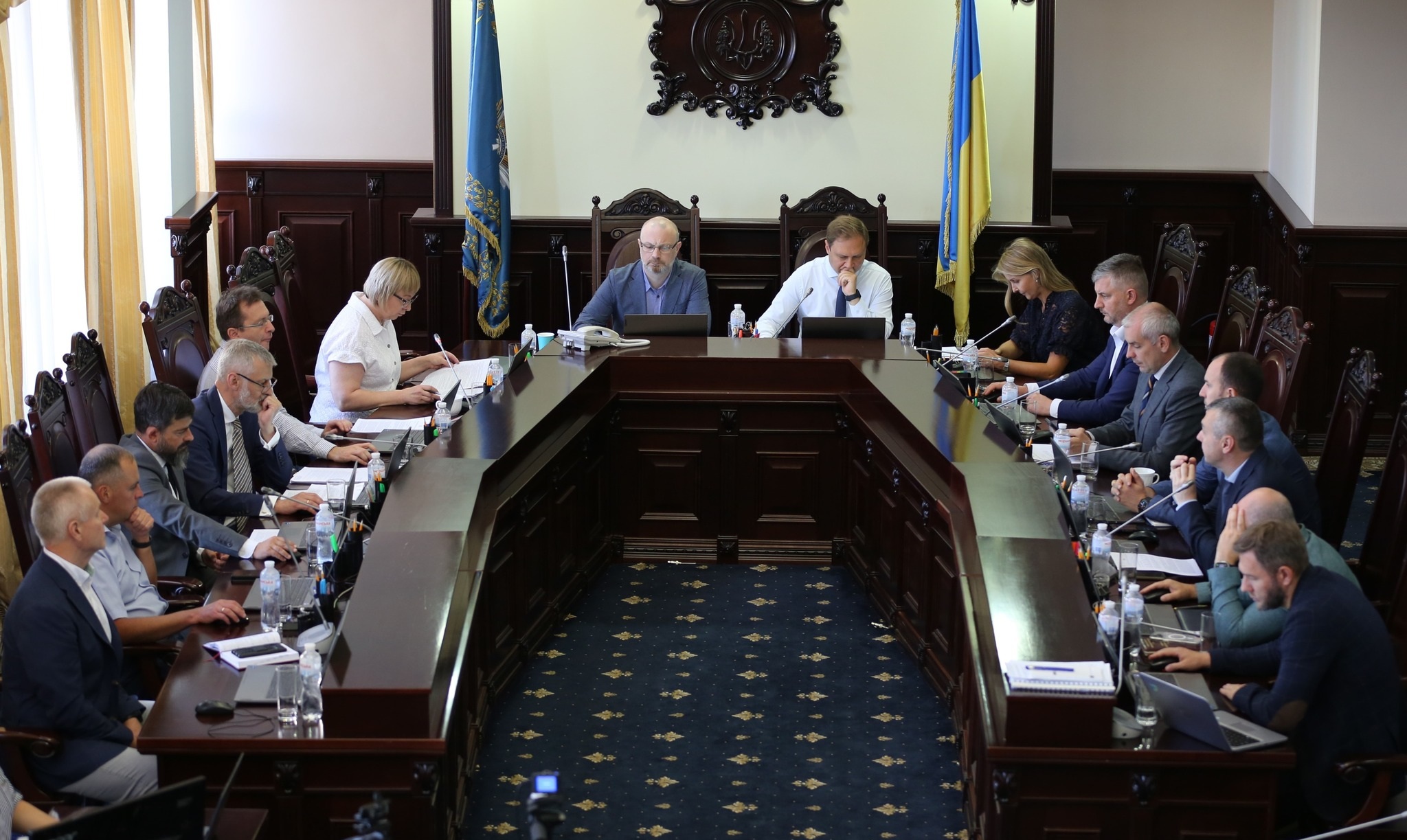
The meeting of the Higher Qualification Commission of Judges, which recommends judges to be appointed to the relevant positions (the photo by the HQCJ)
In the words of Svitlana Blahodietielieva-Vovk, the prevailing majority of the judges’ dissertations, checked by her in 2025, contained violations, plagiarism, first and foremost.
“36 out of 52 dissertations, checked by me, contained plagiarism, this is a gross violation of academic integrity. But there is another aspect – the quality of the scientific product. Here is the dissertation of a judge or a lawyer – this is a mere compilation of text extracts from different authors, based on which the conclusions are made, like ‘so, this is really something regulated, but it is regulated insufficiently’. At most, they might conduct a survey among the employees of the bodies to ask whether they like or dislike something,” the head of “Dissergate” explains.
Anton Zelinskyi tells similar stories. In his words, the main problem lies in the formal nature of defending such papers via the abovementioned “toxic networks” of scientists.
“Considering that there has been no actual control over this sphere till recent times, the ‘service providers’ made minimal efforts to write their theses. Or the judges themselves made minimal efforts to formally defend their dissertations. They received practically no critical remarks regarding plagiarism and other violations, because the successful defence had already been agreed upon,” Zelinskyi explains.
Amusing incidents in scientific papers
Due to the absence of previous review of scientific papers, the members of the PIC and “Dissergate” sometimes find real “treasures” in such dissertations.
For instance, the judge of Yarmolyntsi district court in Khmelnytskyi region, Andrii Soloviov, wrote in his PhD thesis which he defended in the I. Franko National University of Lviv, as follows: “One should not highlight a woman as a person, capable of bearing an implanted human foetus, since the studies of German scientists prove that men are also capable of fulfilling this function”. He took this extract from the Moscow issue of “Literaturnaya gazeta” for 1986, at least, this is what he stated in his dissertation.
“Well, science goes forward. I opened Wikipedia, Internet, found a bunch of references which prove the fact, described in the “Literaturnaya gazeta” many years ago. Different technologies, different models, but it all works. There is no result yet, but…” that was the excuse, made by Andrii Soloviov during the interview.
Usually, the judges are either reluctant or unwilling to admit violations in their scientific papers, as explained by Zelinskyi, “They insist that these are insignificant violations, they might bring the reports from ‘expert institutions’ about the absence of violations, and generally they wonder how it could have happened. Usually, we hear “Oh, I had been working with so many references that I merely forgot what was mine and what wasn’t, that’s why I didn’t make any citations.”
The reaction to judges’ plagiarism
The story of Oleksandr Korolenko may be the most resounding one in terms of the absence of academic integrity in the judicial system. A former employee of the Derzhprodspozhyvsluzhba applied to the competition in the Chernihiv court of appeal, but the PIC found out that his dissertation had 22% match with another scientific paper.
But the most interesting part happened during the interview. At first, Oleksandr Korolenko said that he was interested in becoming a judge because of a high salary and retirement benefits. Also, a member of the HQCJ quoted an extract from the candidate’s application, in which Korolenko stated that in 2019-2022 he had a low salary in the previous job, so he found additional income in writing dissertations for other people. The candidate stated that he spent his profit on a vacation in Thailand, a purchase of mountain gear, and a new iPhone.
“This procedure was the one to find me. My acquaintance came to me and said indirectly, ‘I am looking for a variant to save, to find someone who would write a paper for my wife’, and he named the amount he was willing to pay. We had a deal,” Oleksandr Korolenko told.
Korolenko received USD 6,000 for the first thesis. A year later, the same acquaintance suggested that he write one more dissertation for the same amount. Now, these scientific papers belong to two judges – Olena Vashchuk and Oksana Morozovska. During the interview, Korolenko claimed he could prove that it was he who had written their dissertations.
“I didn’t break any law, I earned this money honestly with my head. Is it normal or abnormal? I know that if I had refused, he would have found another person to do it. There was no ethical dilemma,” Korolenko said.
Immediately after the interview, the HQCJ addressed the High Judicial Court, the Prosecutor General’s Office, and the Ministry of Education with the notification about Korolenko’s confession. However, there is no information about any reaction of any of these structures.
Judge Olena Vashchuk the judge of the Kotovsk city district court of the Odesa region and Oksana Morozovska the judge of the Myrhorod city district court of the Poltava region made no comments on his confession and didn’t give up their scientific degrees either, so they are still receiving additional payments for someone else’s scientific work, if Korolenko is to be trusted.
At present, there is only one known case when a judge gave up his scientific degree on his own, after his dissertation was reviewed. This is Bohdan Bazarnyk, a judge of the Netishyn city court of the Khmelnytskyi region, in whose dissertation they found a number of “loans” from other scientific papers without any references, i.e. academic plagiarism.
“When I found out that the PIC had a number of questions [to the dissertation], I analysed the paper with my scientific advisor. I made a decision to use my legal right of voluntarily giving up my dissertation,” Bohdan Bazarnyk said during the interview with the HQCJ.
However, this decision is an exception. As a rule, “Dissergate” and other scientists try to appeal to the National Agency for Higher Education Quality Assurance (NAHEQA) against unfairly awarded scientific degrees. Only scientists can file complaints.
So far, the only successful case in which the NAHEQA divested a judge of a scientific degree for plagiarism is the story of Oksana Tsarevych, a judge of the Pechersk district court. Last year, she defended a thesis on corruption risks in the sphere of public service provision. The experts found plagiarism in her dissertation and the fact of her publishing someone’s scientific papers under her own surname even prior to the defence, but the scientific council gave her the degree of a Doctor of Philosophy. Only half a year later, this degree was cancelled.
According to the data of the Ministry of Education, a total of only 22 people were divested of a scientific degree due to the detected plagiarism in the last 25 years.
Is it possible to make judges reimburse the additional payments they received along with their salaries?
If it is difficult yet possible to divest a person of a scientific degree, is it possible then to make the plagiarist reimburse the state the payments, received for an unfairly obtained scientific degree? There is no mechanism to do it. Volodymyr Luhanskyi, the abovementioned member of the HQCJ and a retired judge, assured that he could not return this money, “I would like to repay this amount to the state… But I still face bureaucratic obstacles.”
So far, there is only one known case when the judge repaid the additional payment, received for the scientific degree. This was Petro Tarasevych, the judge of Velykobereznianskyi district court in the Transcarpathian region, who also had received a degree from the IAPM which hadn’t been authorized to grant it. When his attention was drawn to this matter, the judge repaid UAH 642 thousand to the account of the SJA in the Transcarpathian region.
“I believe that after it was found out that the money [additional payments for the scientific degree] should not have been paid to me for my diploma, I think that it was right to repay these finances. Which is what I did,” Petro Tarasevych said during the interview with the HQCJ. However, it didn’t help him and the HQCJ declined his application for the position of the judge of the Lviv court of appeal.
In the opinion of Svitlana Blahodietielieva-Vovk, it will be possible to decrease the number of cases of plagiarism and other violations of academic integrity only in case if the state stops making additional payments to state officials for their scientific degrees.
“There are no additional payments for a scientific degree in any other place in the world except for the states of the former USSR. In those times, it existed as practice of buying loyalty, and now, I don’t know, this is some kind of a business system. This additional payment should be abolished. If it concerns scientists and specialists of the education sphere, there should be a remuneration reform,” the head of “Dissergate” is convinced of that.
There have been numerous discussions in the Verkhovna Rada and the Ministry of Education about the possibility of keeping these additional payments only for scientific, and research and educational personnel. And state officials, not dealing with science on a professional level, should lose them.
“These conversations have been going on since 2019,” says Serhii Babak, the head of the Verkhovna Rada committee on education, science, and innovations, in a conversation with NGL.media. “Yet as of now, our committee has no registered draft laws or elaborated initiatives.”
Author Maria Horban, editor Oleh Onysko, infographics Maksym Piho, translation Nelya Plakhota, cover Viktoria Demchuk
