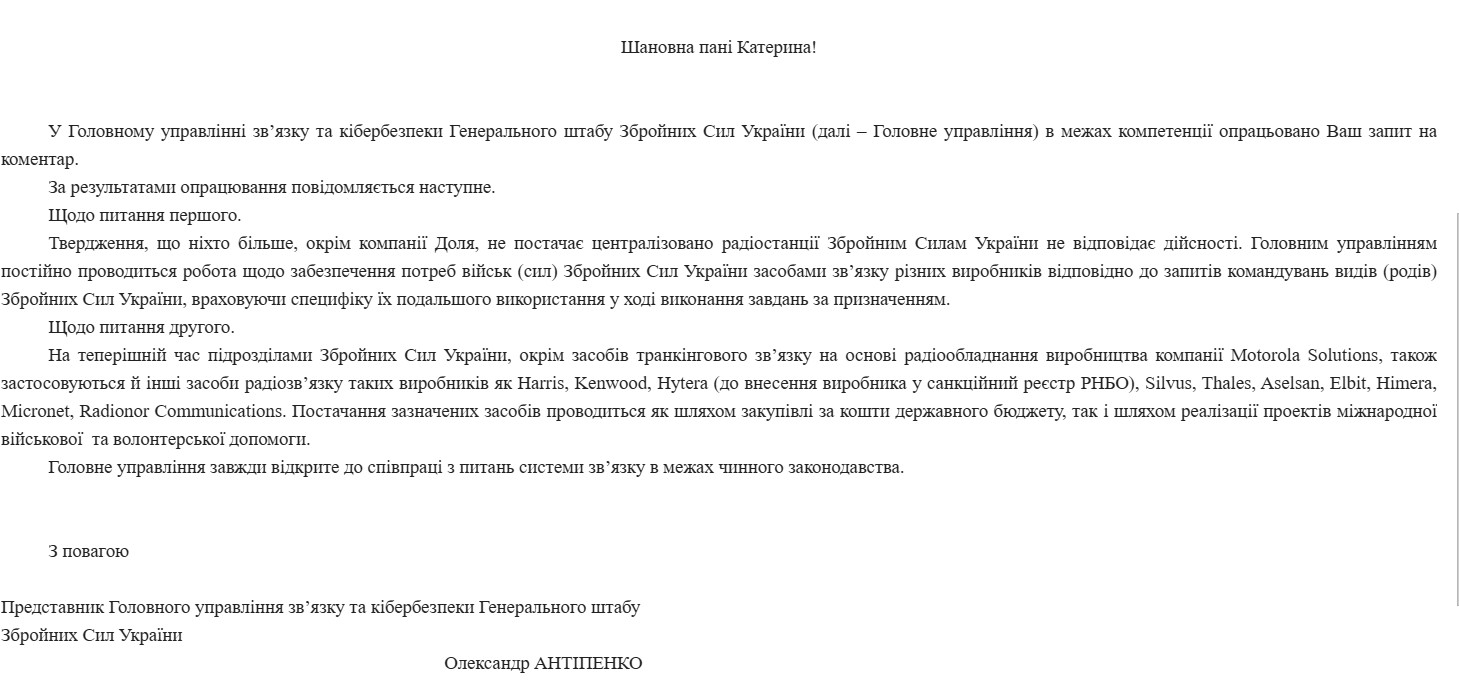
The portable radio sets, produced by the American company, Motorola, are still the main devices of internal communication in the Armed Forces of Ukraine in 2011, the American corporation Motorola split into two independent companies – Motorola Mobility, which belongs to the Chinese corporation, Lenovo Group, since 2014, and Motorola Solutions, which is still American and produces portable radio sets, among other things. These portable radios, which are purely civilian, are used by the army for tactical communications, i.e. during immediate operations. The supplier of these radio sets to the AFU is “DOLYA & CO. LTD” company, one of Ukrainian distributors of Motorola Solutions. Multiple attempts to replace Motorola portable radios with more secure devices of army communication have failed.
“The communications market is monopolised by one producer and one supplying company, and nobody is going to change it now,” says one Ukrainian entrepreneur, who has been working in the military sphere for many years, in a conversation with NGL.media.
Ukraine is not the only one to use commercial radio sets in the army. Although Russia takes pride in the Azart radio sets of its own design, it still uses civilian solutions like the same Motorola In 2022, Motorola Solutions stopped selling its products to the RF and Belarus, but Russians still buy their radio sets via third countries.
There are a number of companies in Ukraine in the communications sphere, but nobody has had any massive production of portable radios before. In 2023, a Ukrainian company, Himera, entered the market and is trying to take this niche, but without any notable results so far. In general, the attempts to enter the market of other producers or suppliers have come to nothing. For years, the Ministry of Defence has been signing closed contracts with “DOLYA & CO. LTD” company, so it is practically impossible to check prices or analyse the terms of cooperation.
NGL.media analysed available data and spoke with many experts, military communications personnel, and producers to understand what enabled the monopoly in the Ukrainian military communications market and what can be done about it.
It should be highlighted that military communication is a large multilayer system, not limited to portable radio sets only. In this material, we focus specifically on these communication devices. For security reasons, we don’t publish the names of some people or sources, who have provided the information. Usually, we don’t base our materials on anonymous testimonies, but since this topic is very important, we decided to keep their comments. The editorial office of NGL.media verified all our interlocutors and sources.
In the right place at the right time
During the first Russian invasion in 2014, the Ukrainian army had many problems, including some in the communications sphere. The servicemen used Soviet radio communication systems and mobile phones, which could be easily detected by the enemy’s intelligence service. At that time, volunteers brought the army everything they could find in the commercial market – Japanese Kenwood, Chinese Baofeng, and other radio sets that were not sufficiently protected against listening-in and geolocation. It was merely dangerous to use them all the time.
It soon happened that the market was entered by “DOLYA & CO. LTD” company. By that moment, it had been working for over 20 years, importing the products of Motorola Solutions to Ukraine, among other things. During the period of critical shortage of communication in the Ukrainian army, “DOLYA & CO. LTD” managed to solve this urgent problem. Both the Ministry of Defence and law enforcement structures started signing contracts with this company. At that time, Motorola portable radios were an optimal, albeit temporary, solution, because they used DMR communication of international standard Digital Mobile Radio; Motorola products, working with this standard, are a separate line, called MOTOTRBO, which, contrary to the analogue, had encryption, though it was not quite protected at that time, portable radio sets used 40-bit encryption keys, which were much easier to break than the 256-bit ones, which were procured later.
“It is not a simple task to obtain the devices of professional military communication from our allies. It takes time, which you don’t have. It was much faster to say, ‘Look, we can buy 10 thousand Motorola portable radios right now.’ Actually, it is a way out of the hopeless situation when you know that these portables will not be safe, they will be vulnerable to the radioelectronic warfare, but, on the other hand, you get portables at once, you can buy and bring them to soldiers very fast,” Thomas Withington, a researcher at the British Royal United Services Institute (RUSI), explains in a conversation with NGL.media.
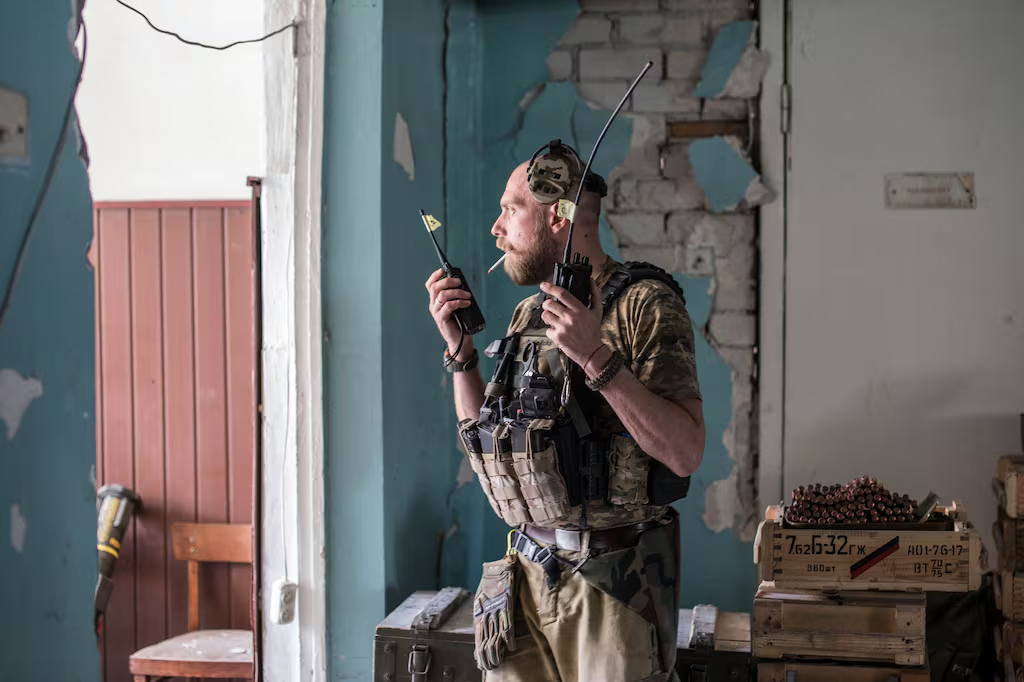
A Ukrainian soldier with the Motorola portable radio set during the battles in Siverskdonetsk in the Luhansk region, June 2022 (a photo by Oleksandr Ratushniak / AP Photo)
Soon, other suppliers of DMR-radios from Motorola competitors tried to enter the communications market, and it caused resistance. The main argument for portable radio sets of Motorola and “DOLYA & CO. LTD” was that the supplier was authorised to work with state secrets it had a special permission, issued after the inspection by the SSU, which allows one to work with sensitive data. Other distributors and producers didn’t have such authorisation, and it was impossible to obtain it urgently. So the Ministry of Defence and the law enforcement structures continued cooperating with the “DOLYA & CO.LTD.” company, agreeing to the conditions and prices set by the only supplier they had.
In 2016, the NABU detectives initiated a criminal case on suspicion that the officials of several defensive institutions the Ministry of Defence, the main department of communications and information systems at the Headquarters of the AFU, the National Guard, and the administration of the State Border Guard Service conspired with “DOLYA & CO. LTD” company and stole budget money using the procurements of the portable radio sets. The NABU was checking the hypothesis that from the very beginning, the procurements of radios were prepared specifically for the supplier, “DOLYA & CO. LTD”, while the proposals of other market participants were rejected using formal reasons.
“It was found that the procurement of portable radio sets using the budget finances was practically prepared for the products of the company [“DOLYA & CO. LTD”]. There were six instances when tender committees made changes to the tender documents and formally rejected proposals from other tender participants that could have been more beneficial. In addition, while importing the mentioned radio equipment and software, the officials [of the “DOLYA & CO. LTD”] used the official documents: correspondence, supply contracts and invoices which appear to have been forged,” says one of the court rulings in this case.
The plaintiff in the case was Oleksandr Doroshenko, the director of the competing company, “Service Centre Kenwood”. He refused to talk to NGL.media.
The materials of the case state that in 2014-2015, the Ministry of Defence and other law enforcement agencies paid “DOLYA & CO. LTD” company a total of about UAH 811 mln. However, the investigation of this case has not been completed yet – the NABU closed it twice due to the lack of evidence and re-opened it pursuant to the court ruling, and then transferred it to the Kyiv Specialised Prosecutor’s Office in the defence sphere. This case is still under investigation It is the assumption based on the response of the Kyiv Specialised Prosecutor’s Office in the defence sphere to the inquiry of NGL.media.
So, “DOLYA & CO. LTD” remained the only company in the tactical army radio communications market and continued supplying Motorola radio sets. But there were ongoing discussions regarding the transfer to more professional military communications.
Attempts to replace Motorola
So what is professional military communication, and how does it differ from the solutions suggested by “DOLYA & CO. LTD”?
“The professional means of military communication have the FHSS system (Frequency Hopping Spread Spectrum), which makes it possible to change frequencies fast. It is required to protect the radiocommunication from interception, jamming and interference. Civilian radio sets don’t have that,” Yevhen Kuchuka, the deputy commander of the communications battalion of the 39th Coastal Defence Brigade, explains in a conversation with NGL.media. “Besides, encryption by the DMR protocol, used in Motorola radio sets, gives too much information in the air, while military communication should not release anything extra. Professional military radio sets often support several ranges and different protocols.”
Modern portable radio models from Motorola Solutions use 256-bit encryption, which is believed to be well-protected. Yet, incidents still happen due to operational mistakes or system vulnerabilities.
“Ukrainian officers remember a case when the Russian headquarters warned its units about the artillery strike, based on the call for some Ukrainian troops to start the fire mission. Ukrainian units communicated using Motorola radio sets with 256-bit encryption, but it seems like Russians managed to intercept and decipher these messages almost in real time,” says the RUSI report, published in May 2023.
In a conversation with NGL.media, one Ukrainian soldier also recalled a recent case in which the enemy managed to penetrate the communications system and access the conversations of one unit. “When we found out about it, we had to urgently make a decision to change the encryption. I can’t disclose any details, but it was a rather massive leak of information,” said a communications specialist of one brigade, holding our grounds in the southern direction.
Prior to the full-scale invasion, there were attempts to equip the Ukrainian army with tactical military radio sets. The variants included the products of the Turkish company, Aselsan, for which a supply contract was even signed, and the products of the Israeli company, Elbit. In 2021, there was information that the key supplier of tactical radio sets for the AFU would be the American company, L3Harris, which is believed to be the reference standard in this niche, and that Turkish sets, Aselsan, which had already been purchased, would be given to the territorial defence units. The US government has been supplying as of April 2025, the company claims to have supplied about 40,000 portable radio sets to the Ukrainian army L3Harris as technical aid, but in limited quantities, so these sets are used only by some special units of the Defence Forces. The Ministry of Defence doesn’t buy these radio sets. One of the reasons may be its high price – depending on the model, the cost of L3Harris radio set is in the range from USD 5,000 to 20,000.
“The situations in 2021 and 2025 are quite different, and whatever was planned in 2021 has to be reconsidered completely. The current situation considerably covers the position of Ukraine’s partners, including the USA, and dynamic changes in their political establishment, the availability of finances, and the possibilities of the Ministry of Defence of Ukraine,” says Yurii Servetnyk, the head of the training and servicing centre of the official representative of L3Harris, “Radio Satkom Group”, in a conversation with NGL.media.
During the full-scale war, the Ukrainian servicemen started using satellite communication, mainly Starlink, but while performing the tasks at the battle contact line, the portable radio sets are still the basic means of communication.
“Starlink really became the alternative to most communication devices which are located further away from the zero ground. At the zero ground, they are also present but used more rarely and are often at risk of detection by the enemy. The antenna for a stationary radio station can at least be disguised well, while any disguise can become an interference for Starlink,” explains a communications specialist from one of the AFU brigades in the Kharkiv direction for NGL.media.
Still in square one
After the Russian invasion in 2022, the size of the AFU increased almost three times in a matter of weeks. At that moment, nobody even thought about transferring to any other military communication devices, because there objectively were more important things to do. In addition, a well-established system had been in place for years. Motorolas were almost everywhere, and it was not only about portable radio sets. Military communication specialists knew these radio sets perfectly and could pass this knowledge along.
“In February 2022, you had a situation when you faced an enormous attack by Russia. You had to gather as many troops as possible to push Russians. It was merely impossible to waste time waiting to buy some other radio sets,” Thomas Withington, a military analyst, explains for NGL.media. “By the way, Russians were in the same situation at the time. They bought not only Motorola radios but also Chinese Baofeng radio stations, which are much worse. But, at the end of the day, it is better to have a commercial civilian radio station than none at all.”
Today, in the fourth year of the full-scale war, Ukrainian servicemen still use Motorola portable radios. It is 80%, or may be 90%, of all the portable radios in the AFU. Only some units are equipped with American L3Harris, and sometimes there are Kenwood, Hytera, Aselsan, Elbit and other radios.
There are different ways for portable radio sets to get to the AFU. Some are procured on a centralised basis by the Ministry of Defence via its units and supplied to military units. Some are bought on a decentralised basis using the budgets of the military units. And finally, servicemen may buy portable radios with their own funds or receive them as aid from volunteers.
Since 2015, the centralised procurement of communication devices is conducted using the consulting procedure. This procedure is an alternative to open sales, in which a client addresses potential suppliers on his own, invites them to submit proposals, and chooses the best one. Since the moment of the full-scale invasion, when the need for communication devices increased several times, the main player in this market remained “DOLYA & CO. LTD” company. This information was confirmed for NGL.media by other distributors of Motorola Solutions company, working in Ukraine. The company has a total of seven dealers, but the Ministry of Defence works only with “DOLYA & CO. LTD”.
There are no published reports on the procurement of the communication devices from the Ministry of Defence, and the request of NGL.media to provide the information about suppliers and the contract prices was declined by the Ministry. The main department of communications and cybersecurity of the Headquarters of the AFU claims that they buy not only from “DOLYA & CO. LTD”, but they haven’t provided any confirmation.
From the response to the inquiry, made by people’s deputy Yaroslav Yurchyshyn, NGL.media managed to find out that in 2024-2025, only the Agency of Defence Procurements (ADP), one of the units of the Ministry of Defence, signed with “DOLYA & CO. LTD” five contracts for supplies of portable radios for the price of UAH 380.8 mln. Before 2024, other structures of the Ministry of Defence dealt with these procurements.
“DOLYA & CO. LTD” doesn’t just sell communication devices of Motorola and other producers, it also manufactures its own products: antennas for portable radios, fittings, relay transmitters, and backpack radios, which it also sells to servicemen. According to the data of YouControl, in 2014-2021, “DOLYA & CO. LTD” declared a total annual income of UAH 300-500 mln. But in 2022, its income skyrocketed to UAH 3.2 bln, and the following year – to UAH 4.8 bln. According to the reports for 2024, the annual income of the company came back to the level of 2022 – UAH 3.2 mln.
The owners of “DOLYA & CO. LTD” company are a couple of Kyivites, Larysa and Andrii Tatarintsev, and their son Yaroslav. Larysa Tatarintseva is also the head of the NGO “Ukrainian Agency of Institutional Development” and is a member of the board of the Public Union “The League of Defence Companies of Ukraine”. Yaroslav Tatarintsev is a co-owner of “Longevity Solutions” company, established in September 2025, which provides services in the sphere of health care. He also owns “Art-T” LLC, which sells electric equipment.
Larysa Tatarintseva refused to answer NGL.media’s question about the company’s monopoly position in the market for supplying portable radios to the servicemen of the AFU.
And what about Ukrainian producers?
At present, the internal market of military communication in Ukraine is represented by only one company, Himera. And it was established after the start of the full-scale invasion in 2022. There are other companies working in the Ukrainian market that specialise in military communication devices, for instance, Telecard enterprise, but they do not produce portable radio sets.
As for Himera radios, they are not used on a large scale, but are tested by some units. The producer claims that these portable radios have specificities, relevant for military communication – FHSS, AES-256 encryption, and support MANET network configuration decentralised wireless network of communication, in which each radio station is an equal node . Now, Himera portable radio set, Himera G1 Pro can be bought for UAH 15 thousand. It is cheaper than Motorola, or even more, L3Harris, and it is cheaper than any other global producer of military communication devices. Himera company explains their low price by the fact that they use more accessible and cheaper components in their production than other producers of tactical communication devices.
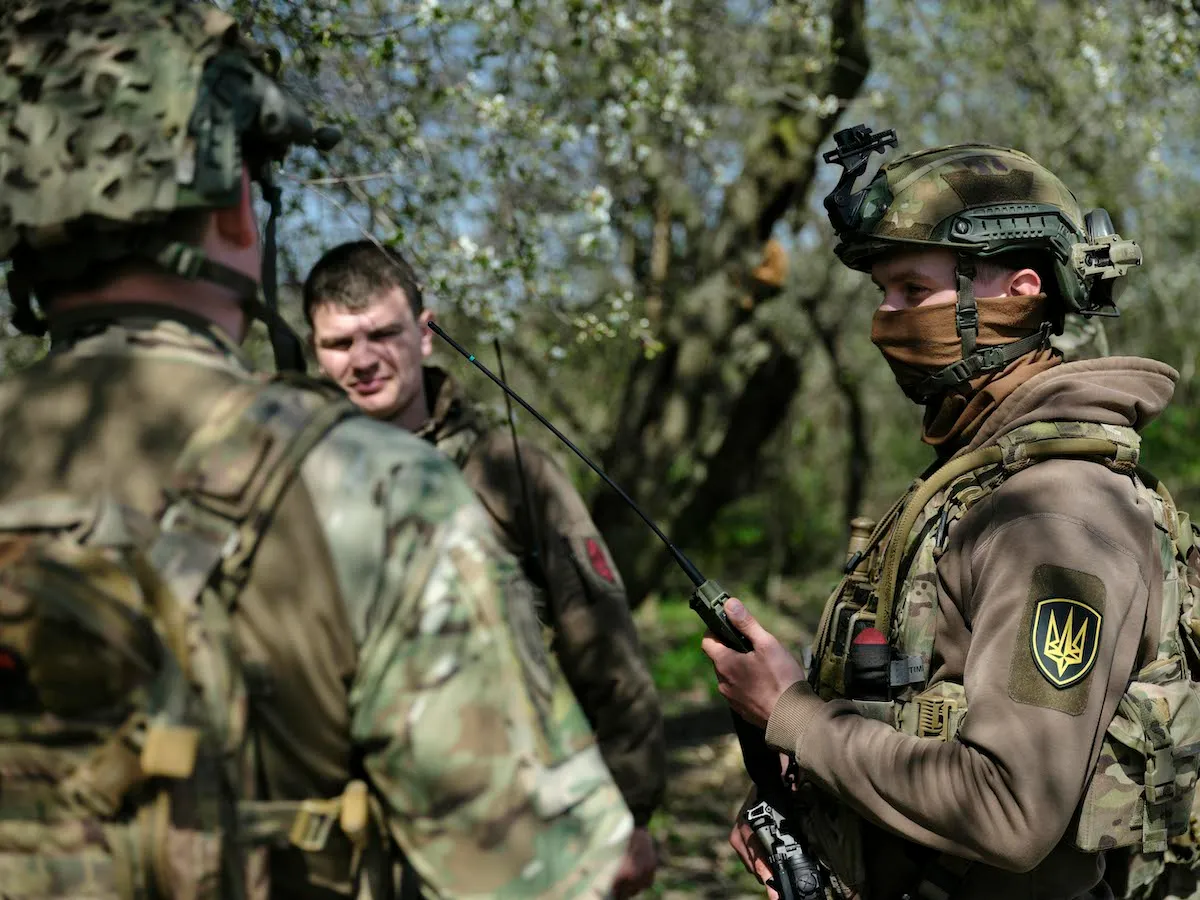
Ukrainian servicemen are testing Himera portable radio sets in the active combat zone, summer of 2025 (a photo by Oleksii Berezovskyi / Monocle)
Yevhen Kuchuka, the deputy commander of the communications battalion of the 39th Coastal Defence Brigade, tests the portable radios of the Ukrainian producer in his units. However, they didn’t reject Motorola radios either: they use them as the main communication device, and the radios of Himera, the Ukrainian producer, which they bought with their own finances, – as a backup.
“Motorola means good communication, their sound quality is great, and they work well with the protocol they are designed for. In general, Motorola is tugging this entire war, but it doesn’t have some elements, relevant for military purposes,” Yevhen Kuchuka explains. “So basically, Motorola is good professional communication. But it was created for special services, airports, civilian institutions, not for military use. So I believe that we should consider other variants and develop in the communication field.”
His colleagues, communications specialists from other brigades, with whom NGL.media has talked, don’t see any variants of complete transfer from Motorola radio sets to other producers either.
“Unfortunately, there are no completely secure radio stations. For security reasons, they periodically upgrade the firmware of radio stations in the army, but it is just a temporary security measure. For instance, the enemy doesn’t care about it, and their Baofeng stations or similar ones, which are UAH 800 in the market [and aren’t secure], were often found. Motorola costs UAH 25-30 thousand on average. But we are assured that at least they are more reliable in protecting the communication,” Oleksii B., a communications specialist, told NGL.media.
Recently, a Ukrainian company Himera supplied its tactical radio sets to the Air Force of the USA for testing. The producer claims that in Ukraine, they conducted trials, the company obtained all the required certificates, and made an ambitious announcement that it is ready to produce 100 thousand devices a year, if there is a demand.
“Our company is already registered with the ADP as a potential producer of the state order. We have passed the required codification and received all certificates, envisaged for our type of products,” Mykhailo Rudominskyi, the CEO of Himera company, assured.
The author Kateryna Rodak, editor Oleh Onysko, translation Nelya Plakhota, cover Viktoria Demchuk
The publication was created within the IWPR project, with financial support from Norway. The editorial office of NGL.media bears sole responsibility for the content of this publication. This material does not reflect the position of IWPR and the Government of Norway in any possible way.